Intown Atlanta neighborhood guide / NPU-N
Reynoldstown: $710,000 buys more square footage here than it did a year ago
Reynoldstown sits about two miles east of downtown, boxed in by freight rail to the north, Moreland Avenue to the east, I-20 to the south and Pearl Street to the west, with the Beltline running straight through the middle of it. For the three months ending September 2026 the median sale price was $709,801, up 0.2 percent on 25 sales in September. The median price per square foot was $319, down 16.6 percent. Those two numbers disagree, and the disagreement is the most useful thing on this page.
Come as you are. Come on home.
At a glance
The facts that do not change every quarter.
Market numbers move. These do not, and they are the ones worth knowing before you start looking at houses.
Where it sits
Four hard edges and a trail down the middle.
Reynoldstown is unusually easy to define, because every boundary is something you can see. That also means every boundary is something you can hear.
North: the rail corridor and Inman Park
The northern edge is the railroad, and specifically the CSX Hulsey Yard. Inman Park is on the far side of it. The practical effect is that Reynoldstown and Inman Park are neighbors who cannot easily reach each other, which is part of why their prices differ as much as they do.
East: Moreland Avenue and Edgewood
Moreland is the eastern boundary, and it is a working arterial rather than a neighborhood street. Cross it and you are in Edgewood, which is where I live. The two neighborhoods share a school zone and a lot of daily routine, and they price differently enough to be worth comparing directly.
South: Memorial Drive, then I-20
Memorial Drive crosses the south end of the neighborhood and carries most of its commercial life. Below that, Interstate 20 is the hard southern edge, with Ormewood Park and an industrial strip on the other side.
West: Pearl Street and Cabbagetown
Pearl Street divides Reynoldstown from Cabbagetown. On foot the two read as one place, and in the data they do not, so a comparable set that treats them interchangeably will mislead you in both directions.
The name travels further than the neighborhood does. Listings south of I-20, east of Moreland, and along the industrial stretch of Memorial that belongs to Grant Park all get described as Reynoldstown with some regularity, because the name sells and the boundaries are not obvious from a map pin. None of those addresses carry the neighborhood’s school zone, its NPU, its civic league or its walk to the park.
There is a second, narrower version of the question. The Reynoldstown Historic District covers 544 contributing buildings and does not cover the whole neighborhood, so a house can be in Reynoldstown and not in the district. The district listing is a federal recognition rather than a local design review, which means it does not, by itself, restrict what you can do to the house. If either boundary matters to you, I would check the specific parcel rather than the neighborhood name.
Housing stock
Shotguns, bungalows, and whatever fit on the lot after them.
For a neighborhood this small, Reynoldstown holds a genuinely wide range of housing, and the range is the reason its per-square-foot number swings the way it does.
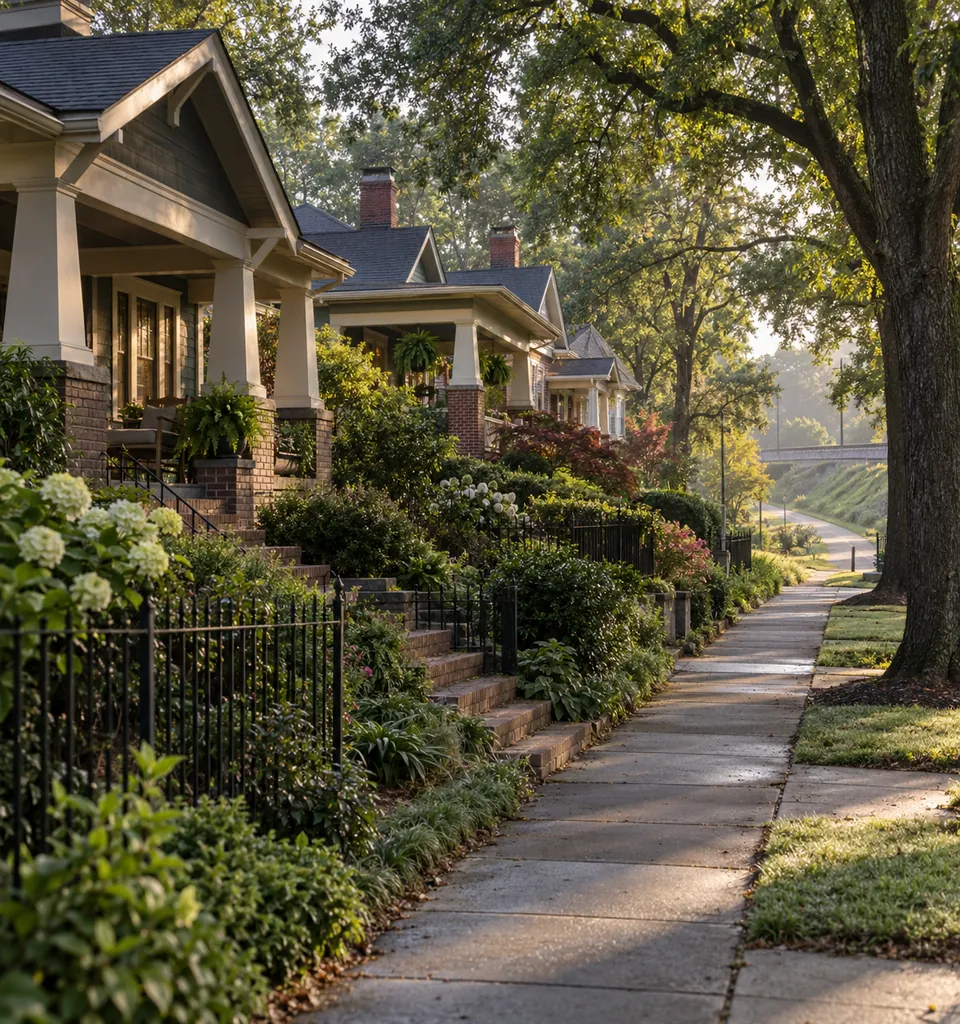
The oldest section. The first houses went up where the two rail corridors met, concentrated on Chester Avenue and Selman Street. The types have proper names worth knowing when you read a listing: gabled-ell, saddlebag, and shotgun, including double shotgun houses on Chester. These are small by modern standards, often beautifully built, and frequently sitting on lots that were platted for a railroad worker’s cottage rather than a 2,400 square foot renovation.
Bungalows, the largest share. More than 36 percent of the district’s historic houses are bungalows, which makes this the type you will see most often. Condition ranges from untouched to taken back to the studs, and two bungalows on the same block can be twenty years apart in effective age. I would read the permit history rather than the listing adjectives.
The 1905 to 1930 subdivisions. Later platting brought Tudor Revival houses, pyramidal cottages and Craftsman bungalows, built for a different set of buyers than the original section. Two schools from that era still stand as landmarks: the John F. Faith Grammar School from 1922, in Romanesque Revival, and the Isaac P. Reynolds Elementary School in International Style.
New infill, and a lot of it. Townhomes and modern single family construction have filled nearly every available site over the last fifteen years, mostly near the Beltline and along Memorial. These are the easiest units to compare to each other and the hardest to compare to anything historic. They are also the product most exposed to the next run that gets built.
Condos, lofts and apartments. Converted industrial buildings and newer mid-rise sit along Memorial Drive and the trail. Madison Reynoldstown, at Memorial and Chester, finished construction in 2024 with more than 100 income-restricted apartments on 1.2 acres. The Lofts at Reynoldstown Crossing sit on the same block. Rental and for-sale product are mixed together here more than in most intown neighborhoods.
What to inspect in a house this old. For anything built before the war, I would hire an inspector who works on older Atlanta construction regularly and ask them specifically about the pier and beam foundation, the wiring, the plumbing configuration and the roof. Those four account for most of the surprises on a 1920s bungalow, and finding them during the inspection period is a very different conversation than finding them in year two.
Why this matters to your offer. A 900 square foot shotgun, a renovated bungalow, a new townhome and a Beltline condo are four different markets wearing one neighborhood name. The Reynoldstown median prices none of them accurately. When I price a house here I build the comparable set by product type and era first, and only then look at what the neighborhood did.
Market snapshot
The median held flat. The price per foot fell 16.6 percent.
Redfin’s figures for the three months ending September 2026. Reading them in the order they are printed will mislead you, so the explanation below matters more than the grid.
Start with the sample. Twenty five sales in a month is small, and in a market that size a handful of unusual closings moves any median several points by itself. Treat everything on this page as a direction rather than a precise reading, and treat any Reynoldstown percentage quoted without a sale count attached as unusable.
Now the disagreement. The median barely moved, up 0.2 percent, while the median price per square foot fell 16.6 percent. When those two separate, the usual explanation is that what sold changed size rather than that values collapsed. Bigger houses closing at similar headline prices will hold a median up while pulling the per-foot figure down. Given how wide the product range is here, from 900 square foot shotguns to new townhomes, a mix shift of that kind is the most likely reading, and it means a buyer is getting more square footage for the same money than a year ago.
What I would not do is conclude that Reynoldstown values dropped 16.6 percent. Nor would I quote the flat median and stop there. If you are buying a specific house, the only number that answers your question is a comparable set built from houses of that size, era and condition, and in a 25 sale market that set may need to reach back further than a quarter.
The activity measures are the cleaner signal, and they lean one way. Sales volume rose 41.6 percent. Days on market came down from 52 to 47. The share of listings taking a price cut fell 22.6 points to 20 percent. That is a market absorbing more homes, faster, with far less repricing than it needed a year ago. At the same time only 8 percent of sales closed above asking, down 8.7 points, and the typical closing landed about a point below the asking price. Demand improved. Bidding wars did not come back. A buyer should still expect to negotiate, and a seller should expect that pricing correctly on day one is what produces the 26 day result rather than a cut three weeks in.
The Beltline
The trail runs through the middle, and part of it is still a construction project.
Reynoldstown is one of the few neighborhoods the Beltline passes through rather than past, which is most of why it costs what it costs. The honest version includes what is finished and what is not.
What is open today. The Eastside Trail runs along the neighborhood’s western side and north through the Krog Street Tunnel. On April 16, 2026 the Beltline cut the ribbon on the final segments of the Southeast Trail, 1.2 miles from Boulevard to Glenwood Avenue, connecting Glenwood Park, Grant Park, Ormewood Park and Boulevard Heights. From the south end of that stretch the trail runs about 1.3 miles north to the Krog Street Tunnel, where it meets the Eastside Trail. The practical result is a long continuous run from here, which was not true two years ago.
What is not finished. Segment 6, along Bill Kennedy Way from Memorial Drive to Glenwood Avenue, has been in an interim condition since 2020: a narrow asphalt path, and temporary lanes across the I-20 bridge protected by movable barriers. As of April 2026 the plan called for phase one, from Glenwood to just south of I-20, to start construction after the World Cup festivities ended in July 2026, taking 12 to 18 months, with a new 14 foot pathway, lighting and street furniture.
The I-20 bridge. The permanent bridge carrying the trail over the interstate is estimated at 18 to 24 months of construction, and as of April 2026 no contractor had been hired. Detours and street closures had not been finalized. If you are buying near the south end of the neighborhood, this is a live construction question rather than a finished amenity, and I would ask for the current schedule before you treat it as either.
What the trail does to a listing. Proximity to the Beltline is priced in here, and it is priced by the block rather than by the neighborhood. A house two streets off the trail and a house backing onto it are not comparable, and the premium does not scale smoothly with distance. Walk the route from the specific front door to the specific trail entrance before you accept the word “steps” in a listing.
The northern edge
Seventy acres of railyard, and nobody has decided anything.
The single largest open question in Reynoldstown is the CSX Hulsey Yard along its northern boundary. It gets described as a coming redevelopment. That is not what it is.
It is 70 acres of freight rail property between Reynoldstown and Inman Park, running east to west along the old rail corridor. In 2019 a community group, the Hulsey Yard Study Committee, produced a master plan with Lord Aeck Sargent setting out what neighbors would want if the land ever changed hands. In early 2020 the Atlanta City Council passed legislation urging CSX to consider those community wishes, including affordable housing, if redevelopment were ever to move forward.
By February 2023 CSX had cleared nearly all shipping containers from the yard and neighbors reported it sitting quiet, which started the speculation again. CSX’s own statement at the time was that it remains an active freight facility and is not for sale. A community master plan is not a rezoning, and a council resolution is not an approval. As of this writing nothing has been sold, nothing has been rezoned, and no redevelopment has been announced.
So here is how I would factor it into an offer. Price the house for the neighborhood as it exists, with an active freight yard on the north side. If the yard is eventually redeveloped, that is upside you did not pay for. If it stays a railyard for another twenty years, you have not overpaid for a promise. I would be cautious about any agent, on either side of the table, who prices in a plan that no owner has agreed to.
One thing the yard already gives the neighborhood: the long wall along Wylie Street is one of the better concentrations of street art in the city, and it is the reason a lot of people’s first visit to Reynoldstown happens on foot.
Getting around
A train station, two arterials, and one detail about the Green Line.
This is a strong transit address by Atlanta standards, with a specific limitation most listings do not mention.
Inman Park / Reynoldstown station. At 1055 DeKalb Avenue, open since June 30, 1979, with 366 free parking spaces. It serves both neighborhoods in the name, and it puts you a short ride from Five Points, where the east-west line meets the north-south line and the airport train.
The Green Line detail. The Blue Line serves this station at all times. The Green Line serves it on weekdays only. If your plan involves the Green Line on a Saturday, it is worth knowing that before you sign, because a listing that says “two rail lines” is technically accurate and practically misleading.
Moreland and Memorial. Moreland Avenue runs the eastern boundary and connects north to the Freedom Parkway corridor and south toward East Atlanta and I-20. Memorial Drive crosses the south end and carries most of the neighborhood’s commercial traffic. Both are genuinely useful and neither is quiet, so the street you buy on matters more here than the neighborhood average suggests.
I-20 and downtown. The interstate is at the southern edge, which makes almost anywhere in the metro reachable and puts highway noise on the southern streets. Downtown is about two miles away. Travel times vary enough by hour that I am not going to print a number I would have to qualify three ways. Sit in the car on a Tuesday at eight in the morning instead, on the route you would really take.
On foot and on two wheels. With the Beltline through the middle and the station at the north edge, this is one of the more genuinely car-optional neighborhoods on the east side. Sidewalk coverage on the older streets is uneven, and parking on the historic blocks is tight, because the lots were platted long before two cars per household.
Green space
One small park that the neighborhood actually runs.
Reynoldstown’s green space is modest in acreage and unusually strong in use, which is a different thing and arguably the better one.
Lang-Carson Park. About 3.24 acres with a recreation center, and the center of neighborhood life. For a neighborhood of this size, having one park that everybody uses tends to do more than having three that nobody organizes around.
The Wheelbarrow Festival. Founded in 1996 and run by the Reynoldstown Civic Improvement League as its flagship event, held at Lang-Carson in September. Live music, an artist market, a kids zone, and cornhole, pickleball and volleyball tournaments. It also includes a .5K, billed as Atlanta’s tiniest race, covering 0.31 miles through the neighborhood. I mention it because a thirty year old volunteer run festival tells you something about a neighborhood that no listing photograph will.
The Beltline as the real park. In practice, the trail is where most people here walk, run and take the dog. That is worth being honest about, because it means the quality of your outdoor life is tied to how far your front door is from a trail entrance, and to the construction status of the segment nearest you.
What is nearby rather than here. Grant Park, Freedom Park and the Carter Center grounds are all a short ride away. If a large park within walking distance is a requirement, Grant Park or Ormewood Park answer that better than Reynoldstown does, and I would rather say so than oversell 3.24 acres.
Where people eat
Two streets carry nearly all of it, and that concentration is the appeal.
Reynoldstown’s commercial life sits almost entirely on Wylie Street and Memorial Drive. If you buy within walking distance of those blocks you get a real dinner neighborhood. If you do not, you get a drive.
Wylie Street. Breaker Breaker at 921 Wylie is Gulf inspired seafood with a rooftop bar called Florida Man. The street also carries the Hulsey Yard murals, which is why it functions as the neighborhood’s front porch on a Saturday.
Memorial Drive. Muchacho at 904 Memorial serves tacos and coffee out of a former rail stop on the Beltline, with a large patio. HomeGrown at 968 Memorial is a brunch and lunch room known for chicken biscuits. La Semilla at 780 Memorial, Unit 4A, is plant based Latin cooking. Hours shift, so I would check before you drive.
Flat Shoals. Parkgrounds at 142 Flat Shoals Avenue is open daily from 8 to 8, serving coffee, pastries, sandwiches and drinks, with a dog friendly patio. It is the closest thing the neighborhood has to a living room.
Music and beer. The Eastern is a large concert venue in the neighborhood, with Three Taverns Imaginarium, a brewery with a two level patio and Monday trivia, directly across from it. A venue of that size on your block is an amenity on most nights and a traffic pattern on show nights, and which one it is depends entirely on how close you are.
Groceries. Madison Yards at 905 Memorial Drive brought a large format Publix to the south edge of the neighborhood, which removed the most common complaint intown buyers used to have about this area. Walkable grocery is rarer in Atlanta than it should be, and it is a real part of what you are paying for here.
What is across the line. Krog Street Market, the Atlanta Dairies buildings and Cabbagetown’s bars are all within a walk, and none of them are in Reynoldstown. That matters when you are reading a listing’s amenity list, and not at all when you are deciding whether you would enjoy living here.
Schools
The zone map goes to a vote on December 7, 2026.
I do not rank or grade schools on this site. What I can do is tell you how assignment works here, and flag that it is being redrawn right now, which is the single most important school fact in Atlanta this year.
The district and the cluster. Reynoldstown is served by Atlanta Public Schools, in the Jackson cluster. Zoned schools are Burgess-Peterson Academy for elementary, King Middle School, and Maynard Jackson High School.
Charter and lottery options. Atlanta Neighborhood Charter School, Drew Charter School, which runs elementary through high school, and Wesley International Academy for kindergarten through eighth are all in reach. Drew and Wesley admit by lottery, which means proximity is not admission. Planning around a lottery seat is a plan with a coin flip in the middle of it.
Independent schools. The New School, serving grades nine through twelve, is in Reynoldstown itself. Paideia in Druid Hills, The Children’s School in Midtown and Wythe Academy in Grant Park are the other options families here tend to look at.
The rezoning, stated carefully. Under APS Forward 2040, the district published preferred attendance zones and ran a survey that closed on October 14, 2026. The board is scheduled to vote on the zones on December 7, 2026, and new zones would take effect in August 2027. Five elementary schools elsewhere in the district are slated to close. I have not seen anything confirming how the Jackson cluster is affected, which is exactly why I would not treat today’s zone map as settled.
One provision worth knowing. APS has said that students whose zone changes but whose current school stays open may remain where they are, though the district would not provide transportation. If you have a child already enrolled, that distinction is worth asking about directly rather than inferring.
How I would check an address. Run the specific address through the district’s school locator, then confirm it with APS rather than relying on a listing’s school field, which is typed in by hand and not maintained. If a school zone is a condition of your purchase, I would put that question to the district in writing before the inspection period closes, and I would ask what the December vote would do to that address.
Corrections
Six things I keep having to walk back about Reynoldstown.
Every one of these is checkable, and every one of them has cost a buyer or a seller real money in a negotiation I have been part of or watched.
1. Quoting the median and stopping. The median was up 0.2 percent. The price per square foot was down 16.6 percent. An agent who gives you only the first number is telling you values held, and an agent who gives you only the second is telling you they fell. Neither is the answer. The answer is a comparable set matched on size, era and condition, which in a 25 sale market takes actual work.
2. Calling everything near Memorial “Reynoldstown”. The neighborhood’s south edge is Memorial Drive, and I-20 below it is the hard boundary. Addresses across I-20, east of Moreland, or on the industrial stretch of Memorial that belongs to Grant Park get marketed under this name regularly. Check the parcel, not the pin.
3. Treating the historic district as the whole neighborhood. The district covers 544 contributing buildings and was listed on the National Register on April 3, 2003. Plenty of Reynoldstown houses sit outside it. And the listing is a federal recognition rather than a local design review, so it does not by itself control what you can do to the house. Both halves of that get stated backwards.
4. Selling the Beltline south of Memorial as finished. Segment 6 along Bill Kennedy Way has been running on a narrow interim path since 2020, with temporary lanes across the I-20 bridge behind movable barriers. Phase one was slated to begin construction after July 2026, and the permanent bridge had no contractor hired as of April 2026. That is a construction zone with a schedule, not a completed trail.
5. Pricing in Hulsey Yard. Seventy acres, a 2019 community master plan, a 2020 council resolution, and a 2023 statement from CSX that the yard is not for sale. No sale, no rezoning, no announced redevelopment. If a listing’s value argument depends on what happens to that land, the argument depends on a decision its owner has not made.
6. Saying the station has two lines. It does. The Blue Line runs at all times and the Green Line runs weekdays only. For a buyer whose weekend plans involve a train, that distinction is the whole point, and it is left out of nearly every listing I read.
The ledger
What the location buys you, and what the rail costs you.
Reynoldstown is a specific trade rather than a compromise. Here is the version I would give you at a kitchen table.
What you gain
The Beltline through the middle of the neighborhood rather than near it. A rail station at the north edge with free parking. Two miles to downtown. Walkable grocery, which is genuinely scarce intown. A dinner and music cluster you can reach on foot if you buy in the right blocks. Architecture with real range, from 1880s shotguns to new townhomes, which means more than one way to get in. A thirty year old neighborhood festival and a civic league that functions. And, for a patient buyer right now, more square footage per dollar than a year ago.
What you trade
Freight rail on the north side and an interstate on the south, both of which you will hear on some streets and not on others. A 70 acre railyard whose future nobody controls. Small lots and tight parking on the historic blocks. A per-square-foot number that swings hard because the sale count is low, which makes pricing harder for a seller and rewards patience in a buyer. An unfinished Beltline segment at the south end. A school zone going to a vote in December. And a neighborhood whose own history is the thing the last two decades of change have been reshaping, which is worth naming out loud rather than skipping past.
Who it fits. Buyers who want the Beltline as a daily habit rather than a weekend outing. People who want to be car-optional and actually mean it. Anyone who would rather own an older house with character than a larger newer one. Buyers who like a small neighborhood where showing up to a meeting changes something. And buyers looking at the per-foot number and seeing an opening.
Who tends to be happier elsewhere. Anyone sensitive to train and highway noise, which is most of what the boundaries are made of. Buyers who need a large park within walking distance, where Grant Park or Ormewood answer better. Families who want a settled school zone this minute. Anyone needing a big garage, a flat yard or room for two cars off street on a historic block. And buyers who want a deep selection right now, since 25 sales a month does not produce one.
The alternatives
What people weigh it against, and the honest version of each.
Almost nobody looks at Reynoldstown alone. These are the five comparisons that come up, with what each one actually trades.
Cabbagetown. Immediately west across Pearl Street, and on foot the two read as one place. Cabbagetown is smaller, denser and tied to the Fulton Bag and Cotton Mill, with its own distinct housing stock. The practical difference for a buyer is inventory: there is less of it, so less chance the right house appears when you need it.
Edgewood. East across Moreland, and where I live. Same school zone, same MARTA line, typically a lower price point, and less Beltline frontage. If the trail through the middle is what you are paying for in Reynoldstown, Edgewood is the version without it, at a discount that is usually real.
Inman Park. Directly north, on the far side of Hulsey Yard. Grander houses, larger lots, a higher price point, and the same station. The yard between them means the two neighborhoods are closer on a map than in daily life. Buyers who can stretch often look here; buyers who cannot usually find Reynoldstown gives them more of what they wanted anyway.
Grant Park. Southwest, across Memorial and I-20. A much larger park, a bigger neighborhood, more inventory at more price points, and no rail station. The trade is park access and selection against transit and trail proximity.
Kirkwood and Ormewood Park. Both a little further out, both generally cheaper per foot, both with more yard. Kirkwood has its own small commercial center and the same train line. Ormewood now sits on the completed Southeast Trail. If the budget is the binding constraint, these are where it usually goes further.
How I would run the comparison. Pick the three you are actually willing to live in, then drive each one at 8am on a weekday and again at 9pm on a Friday. The daytime drive tells you about the commute, and the Friday night one tells you about the noise, the parking and whether you want to be there. That is two hours, and it answers more than a month of listing photos.
Home search
Search homes in Reynoldstown.
Search is handled in one place across Metro Atlanta, so the filters, saved searches and listing detail behave the same wherever you look.
Ask about Reynoldstown
What do you want to know about living here?
Not a general contact form. Ask the specific thing you cannot find out from a listing photo, starting with how loud a particular street is at night and what the Beltline schedule means for that block.
Your details are used to answer your question. No automated sales sequence.
For sellers
Own a home in Reynoldstown?
The share of listings taking a price cut here fell 22.6 points in a year, to 20 percent, and days on market came down from 52 to 47. Sellers who priced correctly on day one did well. Only 8 percent of sales closed above asking, so the premium is not there to be had, and pricing for one is what produces the cut.
What I can tell you
Which sales are genuinely comparable to yours once they are matched on product type, era, size, condition and distance to a trail entrance. In a neighborhood closing 25 homes a month, with product ranging from 900 square foot shotguns to new townhomes, a careless comparable set is not a small error. It is the whole pricing decision. The Reynoldstown median prices none of these categories accurately, and the per-square-foot figure moved 16.6 percent in a year, which tells you how little either number can carry on its own.
If you are not ready to talk yet
There is a seller guide covering the process end to end, from preparation and pricing through offers and closing. No obligation attached to reading it.
Common questions
Reynoldstown FAQ
Seven questions buyers and sellers actually ask.
About two miles east of downtown Atlanta, inside the city limits, in NPU-N. Its four boundaries are the rail corridor and CSX Hulsey Yard to the north, with Inman Park beyond; Moreland Avenue to the east, with Edgewood beyond; Memorial Drive and then Interstate 20 to the south, with Ormewood Park beyond; and Pearl Street to the west, with Cabbagetown beyond. The Beltline runs north to south through the middle. Because the name is marketed loosely, I would confirm the parcel rather than trusting a map pin.
Most likely because what sold changed size. When a median holds and the per-foot figure falls, the usual explanation is that larger homes made up more of the closings, which props up the headline price while pulling down the price per foot. Reynoldstown’s product range runs from 900 square foot shotgun houses to new townhomes, so that kind of mix shift is easy to produce with 25 sales in a month. The practical read is that a buyer is getting more square footage for the same money than a year ago. What it is not is evidence that Reynoldstown values fell 16.6 percent.
Yes, and it is one of the few neighborhoods the trail passes through rather than past. The Eastside Trail runs along the western side and north through the Krog Street Tunnel. The Southeast Trail’s final segments opened on April 16, 2026, which created a long continuous run south. One part is not finished: Segment 6, along Bill Kennedy Way from Memorial Drive to Glenwood Avenue, has been on a narrow interim path since 2020, with temporary lanes over the I-20 bridge. Phase one was slated to start construction after July 2026, and the permanent bridge had no contractor hired as of April 2026.
Nobody knows, and anyone who tells you otherwise is guessing. It is 70 acres of CSX freight property on the neighborhood’s northern edge. A community master plan was produced in 2019, the Atlanta City Council passed a resolution in early 2020 urging CSX to consider community wishes including affordable housing, and by February 2023 the yard had been largely cleared of containers while CSX stated it was still an active facility and not for sale. There has been no sale, no rezoning and no announced redevelopment. I would price a house here for the neighborhood as it is, with an active railyard to the north, and treat any future change as upside you did not pay for.
Atlanta Public Schools, in the Jackson cluster: Burgess-Peterson Academy, King Middle School and Maynard Jackson High School. Drew Charter, Wesley International Academy and Atlanta Neighborhood Charter School are nearby, and Drew and Wesley admit by lottery rather than by address. The important caveat is timing. APS published preferred attendance zones under APS Forward 2040, ran a survey that closed October 14, 2026, and has a board vote scheduled for December 7, 2026, with new zones taking effect August 2027. Run the specific address through the district locator, confirm it with APS directly, and ask what the December vote would do to it.
Closer to balanced than either, and improving for sellers who price correctly. For the three months ending September 2026 sales volume rose 41.6 percent, days on market fell from 52 to 47, and the share of listings taking a price cut dropped 22.6 points to 20 percent. That is real absorption. At the same time only 8 percent of sales closed above asking, down 8.7 points, and the average sale came in about 1 percent under list. So a buyer should expect to negotiate and should not expect to bid against a crowd, and a seller should expect a fair number priced right on day one rather than a premium found later.
Yes. The Inman Park / Reynoldstown station sits at 1055 DeKalb Avenue on the neighborhood’s northern edge, open since June 30, 1979, with 366 free parking spaces. One detail that listings leave out: the Blue Line serves it at all times, and the Green Line serves it on weekdays only. A short ride west reaches Five Points, where you can transfer to the north-south line and the airport train.
Read the two numbers together, then go look at the house.
Reynoldstown rewards a buyer who notices that the median and the price per foot are telling different stories, and who asks which one applies to the specific house in front of them. Whether you are buying here, selling here, or weighing it against Edgewood, Cabbagetown, Inman Park, Grant Park or Kirkwood, the useful conversation starts with the parcel, the street, the distance to a trail entrance and a comparable set built by hand for that product type. Then we can talk about the house.