Metro Atlanta city guide · North Fulton County
Roswell, Georgia: the oldest town on the north side, and the newest argument about it
Roswell is the ninth largest city in Georgia, about 92,800 people spread across a long stretch of north Fulton with the Chattahoochee as its southern edge. It is older than almost everything around it, it has a genuine walkable downtown that the rest of North Fulton had to build from scratch, and it is in the middle of a budget argument and a highway rebuild at the same time. It also costs less than Alpharetta next door, and it is going up while Alpharetta is going down. This guide covers what that actually means for a buyer or a seller.
Come as you are. Come on home.
Start here
A Roswell address is not the same as the City of Roswell.
Roswell has a milder version of the problem Alpharetta has, and it still catches people. The postal footprint is larger than the city, and one of the places inside it is a different city altogether.
30075. The western and central ZIP, about 56,000 people. The Postal Service also recognizes Mountain Park and Sandy Plains as names for addresses in it, which tells you how far past the city line it reaches.
30076. The eastern ZIP, about 44,000 people, toward Johns Creek. Johns Creek is recognized as an alias for addresses in it, which is the same situation in the other direction.
30077. Post office boxes only. No houses in it.
Mountain Park is its own city. About 580 people, in Fulton County, surrounded by Roswell, with its own government. Its city hall address reads Roswell, GA 30075. A house there is not in Roswell and does not pay Roswell’s millage.
Pull the parcel in the Fulton County property records. It will tell you the taxing jurisdiction for that exact address, which settles both the tax question and the city services question. Then run the address through Fulton County Schools’ lookup for the school assignment, which is a separate question with a separate answer.
The city’s own ZIP codes cover close to 100,000 people while the city itself counted 92,833 at the 2020 census. The gap is not enormous, and it is big enough to matter if your house is in it.
The durable facts
Roswell at a glance.
The parts that do not change month to month. Current prices, inventory and pace are tracked separately and sit further down this page.
Orientation
Where Roswell sits, and who it borders.
Roswell touches more jurisdictions than any of its neighbors, including two counties it is not in and a city of 580 people it wraps around.
North: Milton
Larger in land area, more rural, built around horse properties and bigger lots. Roswell is the denser and older of the two by a wide margin.
North east: Alpharetta
The closest comparison and the one most buyers are actually running. Alpharetta is smaller, newer and more expensive. The two share a long border and a good deal of the same buyer pool.
East: Johns Creek
Residential, built out mostly in the 1990s and 2000s, and school driven. Johns Creek is recognized as an alias on the 30076 ZIP, so the addresses blur along that edge.
South: the river, then Sandy Springs
The Chattahoochee is the city line. That gives Roswell real river frontage and park access, and it also means the crossings into Sandy Springs are a fixed number of bridges that everyone shares.
West and north west: Cobb, Cherokee and Mountain Park
Unincorporated Cobb County to the west and Cherokee to the north west, neither of which is Fulton and neither of which is in the Fulton school system. Mountain Park, a separate city of about 580 people, sits inside the Roswell postal area.
Why it looks different
The mill, the houses, and who built them.
Roswell is the only place in North Fulton with a genuine nineteenth century downtown rather than a recreated one, and that is most of why it feels the way it does. It is worth knowing what the history actually is, because listing copy tends to give you half of it.
The mills came first. Roswell King identified the water power on Vickery Creek around 1830 and the cotton mills were built in the mid 1830s. They were built by enslaved laborers. The town was chartered in 1854, two decades after the work started.
1864. Union forces under General Kenner Garrard took the town. On Sherman’s orders the mill workers were shipped north and the mill was burned. The houses were left standing, which is the reason the historic district survives at all. Barrington King rebuilt the mills after the war.
What is left. The mill ruins and a thirty foot dam are still there, now inside the Vickery Creek unit of the Chattahoochee River National Recreation Area. You can walk to them from Canton Street.
The house museums. Three restored former plantation homes are open to the public: Barrington Hall, Bulloch Hall and Smith Plantation. Bulloch Hall was the childhood home of Mittie Bulloch, Theodore Roosevelt’s mother.
The historic district is beautiful and it is the real reason Roswell has a downtown that works. It is also a record of who built it, and the word used in two of those three museum names is not decorative. I am not going to sell you antebellum charm and leave the rest of the sentence off.
None of that is an argument against living here. It is an argument for knowing what you are looking at, which is the same thing I would say about any neighborhood with a history, and most of them have one.
What is actually here
Four decades of housing, not one.
This is the practical difference between Roswell and Alpharetta. Alpharetta went up in one long run between the late 1980s and the mid 2000s. Roswell has been building since the 1830s, and the result is a market with far more variety and far more inspection risk.
The 1970s and 1980s river subdivisions. The largest share of the housing stock. Martin’s Landing is the clearest example, with a median build year of 1978, single family homes averaging around 2,500 square feet, frontage along the Chattahoochee and a 53 acre lake at the center. Pools, fifteen tennis courts and a clubhouse, with HOA dues that run from a few dollars a month to a few hundred depending on the section.
The larger late century communities. Horseshoe Bend is the other name you will hear, with close to ninety percent of its housing built between 1970 and 1999 and a median value in the mid seven hundreds. Bigger houses, bigger lots, and a tighter resale supply than most of the city.
The historic district. Around 866 homes with a median build year of 1991, which surprises people. A handful of genuinely old houses, a good deal of newer infill built to look at home beside them, and townhomes. The median sale over the last year was in the mid five hundreds, with individual historic houses trading far above that.
Newer attached product downtown. Townhomes and apartments around Canton Street and the Southern Post development, which is the part of Roswell that did not exist ten years ago and is the reason the downtown now has people living in it rather than only visiting.
A 1978 house is forty seven years old. Original cast iron or polybutylene plumbing, aluminum branch wiring, two or three roofs ago, and HVAC that has been replaced once if you are lucky. None of that is a reason to walk away and all of it is a reason to budget properly and to use an inspector who knows houses of that vintage rather than one who mostly works new construction.
If any part of a property sits near the river or the lake, I would check the flood maps for that specific parcel. In Martin’s Landing, parts of the River Road and lake area fall in high risk flood zones even though most of the neighborhood does not.
Market snapshot
What Roswell homes are selling for.
Closed sales in Roswell for August 2026, from Redfin data. Prices vary a great deal by era and by which part of the city you are in, so treat these as a starting point rather than a verdict on any one property.
In the same month Alpharetta’s median was about $790,000 and down 1.6 percent year over year. Roswell’s was $707,500 and up 4.4 percent. So you are paying roughly eighty thousand less at the median in the city that is appreciating, not the one that is flat.
That is a real finding and it is not a reason to buy on its own. One month is one month, the two cities have different housing stock, and a median moves when the mix of what sold moves. What it does tell you is that the common assumption, that Alpharetta is the better buy because it is the more expensive address, is not supported by this year’s numbers.
The nine extra days on market and the five point drop in homes selling above list are the softening signal. A prepared buyer has more room here than they did a year ago.
Schools
How to research schools for a Roswell address.
I do not rank schools or tell anyone which one is good. What I can do is make sure you are researching the right one, which in this part of the county is less obvious than it looks.
There is no Roswell city school district. Fulton County Schools serves the city. If you are comparing Roswell against Decatur, that is one of the real differences between them.
Roswell sits in Fulton’s Learning Zone 5. The two high schools in that zone are Roswell and Centennial. The middle schools are Crabapple, Elkins Pointe, Haynes Bridge and Holcomb Bridge.
The zone is not the city. Learning Zone 5 also includes elementary schools in Sandy Springs. Being in the zone and being in Roswell are two different statements, and the zone boundaries have been redrawn before.
West of the city line changes everything. A house in unincorporated Cobb or Cherokee with a Roswell mailing address is in a different county school system entirely. That is the single biggest school trap in this market.
Run the specific street address through Fulton County Schools’ address lookup. If the parcel turns out to be in Cobb or Cherokee, the lookup moves to that county’s system. That returns the assigned elementary, middle and high school for that parcel. If a particular school is the reason you are buying, call the school and confirm before the due diligence period ends. I would not rely on a portal, a listing remark or a neighborhood name for this.
The walkable part
Canton Street, and the downtown being built around it.
This is Roswell’s actual advantage over every other city on the north side. Alpharetta built Avalon from nothing in 2014. Roswell’s downtown has been there since the 1800s and has been filling in around itself ever since.
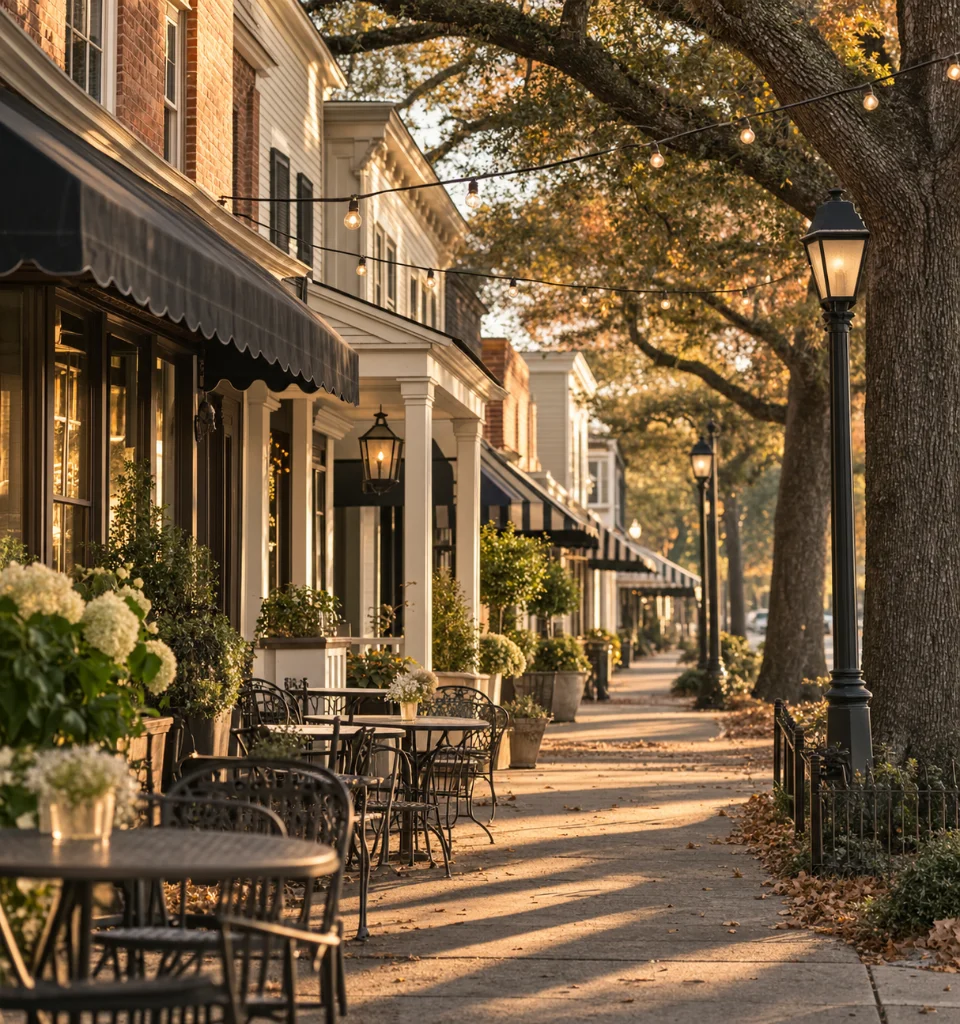
Canton Street. Named a Georgia Great Street, with more than thirty restaurants and shops along it and the sidewalk dining to match. Alive in Roswell takes over the street on the third Thursday of the month from April through October.
Southern Post. Office, retail and residential built on a former strip shopping center, and the project that gave downtown a resident population rather than only a visiting one. Vestis chose it for its corporate headquarters.
The Chambray. A 125 room boutique hotel next to Southern Post, which broke ground in February 2026 and is targeting a summer 2027 opening. It is the first project backed through the city’s development finance program.
Parking and circulation are changing now. A 395 space public deck at Green and Alpharetta Streets was expected to open in summer 2026, Green Street went one way southbound in January 2026, and Plum Tree Street is being converted into a pedestrian link toward Canton Street. If you tour downtown and the traffic pattern feels odd, that is why.
What is still ahead. Hillrose Market near City Hall is planned at 75,000 square feet of commercial space with 143 apartments and 16 townhomes, with openings expected around late 2027. A redevelopment of roughly 47 acres at Highway 9 and Holcomb Bridge is at the nonbinding agreement stage and is a multiyear process, not a settled plan.
Walkability in Roswell is specific, not general. The historic district scores around 60 for walkability, which is real. Most of the rest of the city is a car market like any other North Fulton suburb. If walking to dinner is the point of moving here, the search needs to be drawn tightly around downtown, and that is a much smaller and more expensive slice of the city than the Roswell median suggests.
Getting around
One interchange, and seventy thousand cars a day.
If you read one section before you buy here, I would make it this one. Roswell’s relationship with GA 400 is the defining practical fact about living in it, and it is not the same as Alpharetta’s.
Holcomb Bridge Road is the only way on. The city’s own transportation department describes it as Roswell’s single access point to SR 400. The interchange carries more than 70,000 vehicles a day and is the most heavily traveled east to west interchange north of I 285. Alpharetta has five interchanges. Roswell has this one.
The interchange is being rebuilt. Improvements at Holcomb Bridge are part of GDOT’s SR 400 express lanes project: sixteen miles of tolled lanes from the MARTA North Springs station north past McFarland Parkway, with construction beginning in the second quarter of 2026 and an expected opening in 2031. Expect several years of disruption on the road you most need.
Big Creek Parkway is the city’s answer. Phase 1 construction near Holcomb Bridge and Warsaw Road ran through spring and summer of 2026, with turn lanes, a widened Warsaw Road, sidewalks and a trail. A second phase would bridge GA 400 north of Holcomb Bridge and link Warsaw Road to Old Alabama Road, which depends on state coordination. GDOT is also considering a third east to west connection south of Holcomb Bridge.
Bus rapid transit is designed, not built. MARTA’s GA 400 BRT plan would run buses in the new express lanes from North Springs north, and Holcomb Bridge Road is one of four proposed stations. The project status is design and no opening date has been published, so I would not price a house on it.
The river limits your options south. The Chattahoochee is the city’s southern boundary, so getting to Sandy Springs and the perimeter means one of a fixed number of bridges. When 400 backs up, the alternates fill fast.
The trails are genuinely useful. More than 900 acres of parkland, the Vickery Creek unit of the Chattahoochee River National Recreation Area, the Roswell Riverwalk, the Vickery Creek Trail and the Big Creek Greenway. You can walk from Canton Street to the mill ruins and the dam.
Drive the commute you would actually drive, on a weekday, at your hour, before you commit. Then drive it again from the specific house. Where you sit relative to Holcomb Bridge Road changes your morning more than almost any other decision you will make here, and two houses five minutes apart on a map can be twenty minutes apart at eight in the morning.
If you work on the west side or in Cobb, Roswell is often the easier address than anywhere further up 400. If you work downtown or in Midtown, price the house on the road as it is now, not on 2031.
What you pay
The city just raised taxes, and nearly raised them a great deal more.
This is current, it is specific to Roswell, and no listing page will tell you about it. It is also a window into how the city is being run, which is worth more to a buyer than the dollar figure.
The mayor’s case for the larger increase was deferred maintenance. Roughly 33 vehicles in a fleet of about 480 were in poor condition, some fire engines were 22 or 23 years old against a typical 15 year life, and the city needs to resurface 360 miles of road while last year’s budget covered 14. She said she would rather raise the rate than take on more bond debt.
Residents pushed back at the September hearings and the council landed well short of the proposal. The mayor has said she intends to revisit the capital needs in the 2027 budget. I am not going to predict what happens, and I would factor in that the question is not closed.
Roswell’s 5.232 is lower than Alpharetta’s 5.750, which looks like the end of the story and is not. Alpharetta grants a $45,000 basic homestead exemption against its city levy. Roswell’s published city exemptions are the floating cap, senior exemptions of $2,000 at 65 and $20,000 for seniors under a $40,000 income threshold, and a disabled veteran exemption, and apart from the veteran one they apply only to the general fund portion.
Two houses at the same price in the two cities can carry different annual costs in either direction depending on which exemptions you qualify for. Compare the actual bill on the actual parcel, and include the HOA while you are at it.
Straight talk
What agents get wrong about Roswell.
Most of these come from treating Roswell as Alpharetta’s cheaper cousin, which gets both cities wrong.
Calling it the budget option. Roswell is less expensive at the median and it went up 4.4 percent this year while Alpharetta went down 1.6. Pricing it as a discount version of the city next door misreads what is actually happening.
Selling walkability citywide. The historic district is walkable. Most of Roswell is not, and the gap between the two is large. A Canton Street lifestyle has a specific and much narrower set of addresses attached to it.
Skipping the commute conversation. One interchange, 70,000 vehicles a day, and a rebuild running to 2031. An agent who shows you houses on both sides of Holcomb Bridge Road without mentioning what that means for your morning has not done the job.
Inspecting a 1978 house like a 2008 house. Most of the stock here is decades older than the stock in the newer cities nearby. Plumbing, wiring, roofs and systems are all live questions, and a generalist inspection on a house of that vintage is not enough.
Missing the county line. A Roswell mailing address west of the city line can be in unincorporated Cobb or Cherokee, which means a different county, a different school system and a different tax bill. Pulling comps or quoting schools off the mailing city gets this wrong every time.
Leaving the tax increase out. The city raised its rate in September after advertising a 56 percent increase, and the mayor has said she will revisit capital needs in the 2027 budget. A buyer deserves to hear that from their agent rather than from the bill in late October.
Selling antebellum charm with the history edited out. The mills were built by enslaved laborers and two of the three house museums have the word plantation in their story. You can love this town and still say that out loud. I do.
An honest accounting
The trade offs, stated plainly.
I would rather you decide against Roswell for the right reason than move here and find out what you traded.
What you gain
A real downtown with thirty years of history behind it rather than a built one. More than 900 acres of parkland and genuine river access. Roughly eighty thousand dollars less at the median than Alpharetta, in a market that is currently appreciating rather than flat. A city millage lower than its neighbor’s. Housing with variety in it, from 1970s river subdivisions to historic houses to new townhomes downtown. And a sense of place that the rest of North Fulton has spent two decades trying to manufacture.
What you trade
One interchange onto the highway everyone uses, under construction until 2031. Older housing and the maintenance that comes with it. Walkability that exists in one district and not citywide. A city budget under visible pressure, with a tax question that is not settled. Schools that are good but are county schools, which means boundaries can move. And a western edge where the mailing address and the jurisdiction come apart.
In context
How Roswell compares to the alternatives people actually weigh.
Nobody shops Roswell on its own. These are the comparisons that come up in my consultations, with the honest version of each.
Against Alpharetta. The big one. Alpharetta is newer, smaller, more expensive and has five ways onto 400. Roswell is older, larger, cheaper at the median and has one. Alpharetta’s walkable districts were designed; Roswell’s grew. If you want a house built this century with less to fix, Alpharetta. If you want character, parkland and a better price, Roswell. Read the Alpharetta guide →
Against Milton. More land and more privacy in Milton, higher prices at the top, and far less to walk to. People who want acreage choose Milton. People who want a downtown choose Roswell. Read the Milton guide →
Against Sandy Springs. Just across the river and much closer in, with better access to the perimeter and to MARTA rail, at the cost of the small town feel and usually at a higher price per foot. If the commute is the binding constraint, Sandy Springs deserves a look before Roswell does.
Against East Cobb. Similar vintage of housing, similar school driven demand, generally lower prices, a different county and a different highway problem on I 75. Worth running both if the school is the goal.
Against staying intown. Intown you pay for walkability, age and proximity. Here you pay for space, parks and schools, and Roswell is the north side address that gives you the most walkable square footage for the money. At the same number you get a very different house and a very different week. I have lived on both sides of that line and I will not pretend one answer fits everyone.
Home search
Search homes in Roswell.
Search is handled in one place across Metro Atlanta, so the filters, saved searches and listing detail behave the same wherever you look.
Ask about Roswell
What do you want to know about living here?
Not a general contact form. Ask the specific thing you cannot find out from a listing photo, including whether a particular address is actually in the city.
Your details are used to answer your question. No automated sales sequence.
For sellers
Own a home in Roswell?
The same boundary that confuses buyers is what makes an automated estimate unreliable on your house. A tool that cannot tell which side of the line an address sits on cannot select the right comparable sales for it.
What I can tell you
Which sales are genuinely comparable to your house once they are matched on jurisdiction, product type, age, condition and where in the city you are, and what is actually competing with you right now. Not a postal-city average, not a ZIP-level figure, and not a headline number drawn from a sample too small to describe your street.
If you are not ready to talk yet
There is a longer write-up on how Roswell pricing works from the seller’s side, and a seller guide covering the process end to end, from preparation and pricing through offers and closing. No obligation attached to reading either.
Common questions
Roswell FAQ
Seven questions buyers and sellers actually ask about this city.
Usually, but not always. The Roswell postal area covers close to 100,000 people while the city counted 92,833 at the 2020 census. The 30075 ZIP also carries Mountain Park and Sandy Plains as recognized address names, and 30076 carries Johns Creek, so the edges blur in both directions. Mountain Park in particular is a separate incorporated city of about 580 people whose city hall address reads Roswell. The parcel record in the county property search settles it in about a minute.
No. Fulton County Schools serves the city, and Roswell sits in the district’s Learning Zone 5, whose high schools are Roswell and Centennial. The zone is not the same as the city, since it also includes schools in Sandy Springs, and a Roswell mailing address west of the city line can fall in Cobb or Cherokee County entirely. The district’s address lookup for the specific property is the only reliable answer.
The median sale price in August 2026 was $707,500, up 4.4 percent from a year earlier, with a median of 36 days on market and 354 homes sold. Homes sold at about 98.4 percent of list and 21.2 percent sold above asking, both down from a year ago. The range behind that median is wide, because the housing stock runs from 1970s subdivisions to historic houses to new townhomes, so a figure for a specific neighborhood is far more useful than a figure for the city.
At the median, yes, by roughly eighty thousand dollars as of August 2026. The part people miss is the direction of travel. Roswell was up 4.4 percent year over year in that month and Alpharetta was down 1.6 percent. The city millage is lower in Roswell too, at 5.232 against 5.750, though Alpharetta grants a larger basic homestead exemption, so the actual bill depends on the parcel and on which exemptions you qualify for.
It depends almost entirely on where in the city you are. Holcomb Bridge Road is Roswell’s only access to GA 400, the interchange carries more than 70,000 vehicles a day, and the city’s own transportation department calls it the most heavily traveled east to west interchange north of I 285. That interchange is being rebuilt as part of the GA 400 express lanes project, which began construction in the second quarter of 2026 and is expected to open in 2031. Two houses five minutes apart on a map can be twenty minutes apart at eight in the morning, so drive it yourself from the specific address before you commit.
Yes. On 28 September 2026 the City Council voted four to two to adopt a millage rate of 5.232, up from 4.949, an increase of about 5.7 percent. The whole increase sits in the debt service portion, which went from 0.900 to 1.183 mills to repay voter approved bonds, while the operations portion stayed at 4.049. The city had originally advertised 7.732 mills, which would have been a 56 percent increase, and council advanced 5.9 mills earlier in September before landing on 5.232. For a home with a $575,000 fair market value the city portion works out to about $1,203 before exemptions, against about $1,138 at the old rate.
The historic district is, with a walk score around 60 and more than thirty restaurants and shops on Canton Street, plus Southern Post, the town square and trail access to Vickery Creek and the river. The rest of the city is a car market like most of North Fulton. If walking to dinner is the reason you are moving, the search has to be drawn tightly around downtown, which is a smaller and more expensive slice of Roswell than the citywide median suggests.
Find out which side of the city line you are on before you fall for the house.
Whether you are buying in Roswell, selling here, or weighing it against Alpharetta, Milton, Sandy Springs or somewhere back inside the perimeter, the useful conversation starts with the parcel, the school assignment and the right comparable set, not with a number attached to a mailing city.