Atlanta neighborhood guide · DeKalb County
Kirkwood Atlanta Neighborhood Guide: What It’s Really Like to Live Here
Kirkwood is a City of Atlanta neighborhood on the east side, roughly five miles from downtown, founded in 1899 as its own town and annexed decades later. Residents call it the small town in the big city, and the description is closer to literal than it sounds: a business district, a post office, a library, a fire station and a police precinct all sit within walking distance of the bungalows. This guide covers what stays true about Kirkwood, starting with the thing that trips up the most buyers and the most agents: on a single Kirkwood street you can find a preserved historic house, an extensively renovated one, brand-new construction and a new build raised on a foundation from the 1920s. The nearest sale isn’t automatically the right comparable here, and knowing which is which is most of the job.
Come as you are. Come on home.
The durable facts
Kirkwood at a glance.
The parts that do not change. Current prices, inventory and pace are tracked separately, and the route to them is further down.
Orientation
Where Kirkwood sits, and what surrounds it.
Kirkwood is a named neighborhood inside the City of Atlanta, not a separate municipality, though it was one once. Its neighbors matter here, because two of them are routinely mistaken for it.
North: toward Candler Park and the rail corridor
The MARTA line and the Edgewood/Candler Park station sit off the northern side, with Candler Park and Lake Claire beyond.
East: East Lake, then Decatur
East Lake sits directly east, and the City of Decatur beyond it. Oakhurst, which is sometimes described as walkable from Kirkwood, is a Decatur neighborhood on the far side of East Lake rather than a Kirkwood amenity. Decatur guide →
South: Memorial Drive and I-20
I-20 runs along the southern side, with Memorial Drive between it and the neighborhood.
West: Edgewood
The two run together along Hosea L Williams Drive. Where one ends and the other begins is local convention rather than a posted line, which is why a small number of homes get marketed as both, and why any comparable-sales work near that edge needs a stated boundary rather than a neighborhood name. Edgewood guide →
Housing stock
Buying a hundred-year-old house is a different transaction.
Kirkwood’s streetscape is the reason most buyers come, and it is also the part of the purchase that most often surprises them. The architecture is the easy half. What sits behind it is the half worth reading.
What is actually here
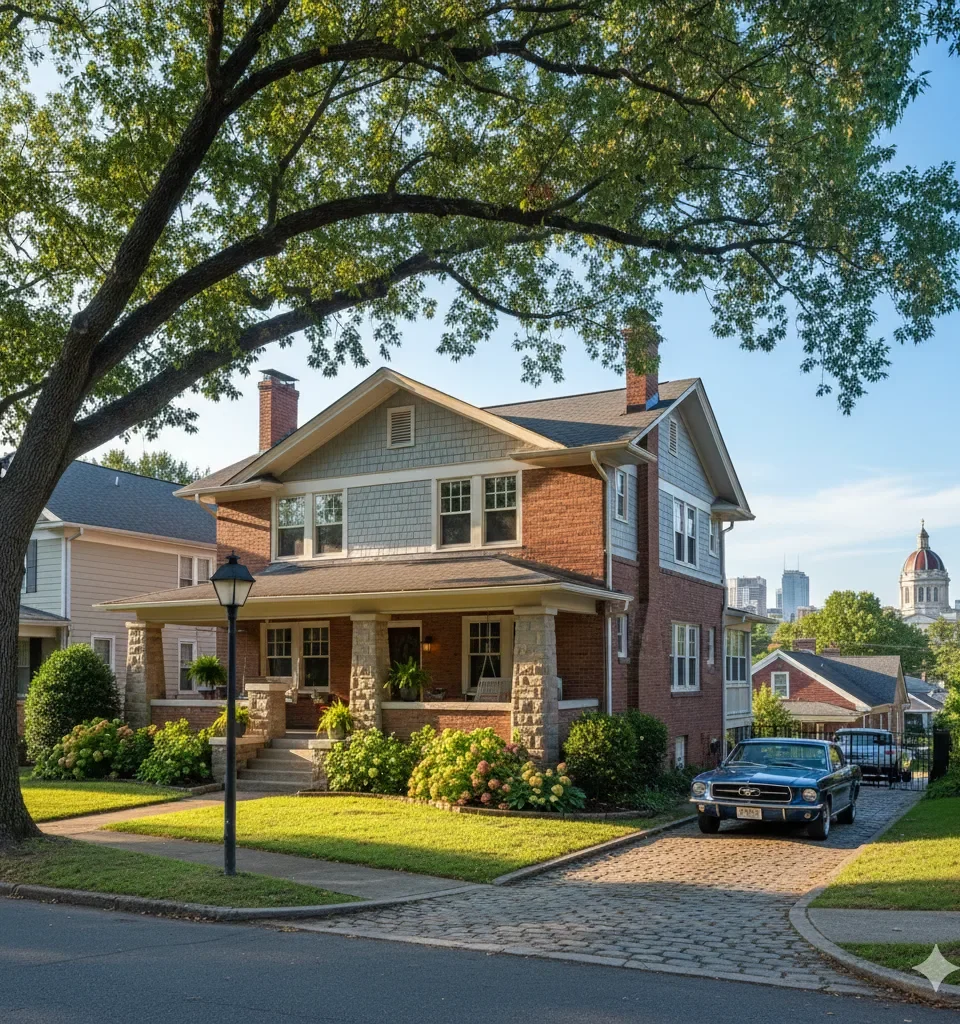
Craftsman bungalows dominate, alongside Victorian cottages, American Foursquares and Colonial Revivals, most of them built in the decades on either side of 1900 when Kirkwood was still its own town. Deep front porches, large lots relative to the footprint of the house, a mature tree canopy and a level of exterior detail that newer construction does not attempt. Newer attached product, including townhomes and condos, has entered in pockets, concentrated toward the Pullman Yards corridor.
Four different products, often a few doors apart
Kirkwood does not have one kind of house in a range of conditions. It has at least four distinct products sitting beside each other, sometimes within a few houses on the same street: a preserved historic home, an older home that has been extensively renovated, brand-new modern construction, and homes that combine the two. That last category includes new builds raised on the foundation of a house from the 1920s or 1930s, which is neither an old Kirkwood home nor straightforward new construction. This is the defining fact about buying and pricing here, and the rest of this section follows from it.
Historic designation has practical consequences
The Kirkwood historic district is not only a distinction. It can carry restrictions on exterior modifications, which matters enormously if you are buying with a renovation in mind. Before you fall for a project, find out what the district does and does not allow for that specific property. This is a question to answer before the offer, not during the permit.
Older housing stock is worth inspecting with that in mind
Homes of this age may contain systems and construction methods that newer houses do not, including knob-and-tube wiring, original galvanized plumbing, pier-and-beam foundations and older mechanical systems. Experience inspecting older housing stock is useful here, so it is worth asking an inspector about their background with homes of this era before you book.
What homes cost
Kirkwood is where a single number goes most wrong.
Prices, inventory and pace change constantly, so current figures are tracked in the market reporting rather than written into this guide. What belongs on this page is the part that does not expire: why a headline Kirkwood number usually describes nothing, and what to compare instead.
The numbers change. This guide is not the place that tries to keep up with them.
Current Kirkwood prices, inventory and sales pace are tracked separately from this guide, so the figures you see are dated and sourced rather than quietly aging inside page copy. The neighborhood guide covers what stays true about Kirkwood. The market reporting covers what is true right now.
How pricing works here
Three things that stay true whatever the market is doing.
These are the reasons a headline Kirkwood figure, wherever you find it, usually does not describe the house in front of you.
A 30317 number is not automatically a Kirkwood number
Kirkwood is in ZIP code 30317, but 30317 is not only Kirkwood. It also covers East Lake and Edgewood, and those price differently. Any figure attached to the ZIP, including the ones inside national portals and automated estimates, is averaging several neighborhoods together, so ZIP-level data should not be presented as Kirkwood neighborhood data without saying so. If the number you have been handed came from a ZIP, ask what it actually measured, because the gap is routinely large enough to change how a house looks on paper.
The closest sale isn’t automatically the right comparable
This is the one that costs people money. Because preserved, renovated, new and hybrid houses sit side by side here, proximity tells you almost nothing about comparability. A smaller thoughtfully renovated house can carry a higher price per square foot than a larger untouched one on the same block, and both can be correctly priced. Match on what the house actually is first, then on size, then on distance. An average price per square foot taken across all four products describes none of them.
Attached and detached are different products
The newer townhomes and condos near the Pullman Yards corridor are not small versions of the bungalows. Different land, different shared structure, different carrying costs and a different buyer. They should be compared against each other rather than measured against a neighborhood figure drawn mostly from detached houses.
On the ground
Kirkwood gets priced by proximity when proximity is the least reliable thing about it.
Five things worth correcting, including with other agents.
Pricing Kirkwood off a ZIP code
30317 also carries East Lake and Edgewood. An automated estimate, a portal figure or a market report attached to it is averaging all of them. An out-of-town agent working from that number will misprice a Kirkwood house in one direction or the other, and the width of Kirkwood’s own range makes the error larger here than it would be in a more uniform neighborhood.
Assuming the closest sale is the right comparable
I represented a buyer on a modern Kirkwood home that had been built on the foundation of a house dating to roughly the 1920s or 1930s. That made the comparable analysis genuinely difficult, because the property was not simply an older Kirkwood home and it was not straightforward new construction either. Neither set of comps fit it cleanly.
That is the harder version of something I run into across Kirkwood and Edgewood both. Within the same neighborhood, on the same street, sometimes a few houses apart, you can have an older home that has been extensively renovated, a preserved historic home, brand-new modern construction, or something that combines old and new. You cannot assume the closest sale is the right comp just because it is nearby. You have to understand what you are actually comparing.
Selling trail access as BeltLine frontage
Kirkwood is not on the BeltLine. What it has is trail-connected access to it, which is a real amenity and a different one. A buyer who was told BeltLine and finds a connector trail has been sold something that was not accurate, and they usually work it out on the second visit. The getting-around section below says exactly what the connection is.
Assuming a station on the map means a walkable commute
Rail access from Kirkwood varies enough by address that it is a genuinely different proposition block to block. KJRE’s own existing pages describe it two different ways, which is itself the point. Map the trip from the specific property rather than from the neighborhood name.
Reading historic designation as only upside, or only restriction
It is both, and which one matters depends entirely on what you intend to do with the house. An agent who mentions the designation as a selling point and never raises what it regulates has given you half the fact.
You cannot assume the closest sale is the right comp just because it is nearby. You have to understand what you are actually comparing.
Kristen Johnson · REALTOR® · Edgewood resident, directly west of Kirkwood
The thing everyone asks about
Pullman Yards, both halves of it.
A large former industrial site on the Kirkwood edge, redeveloped into an entertainment district. It is the neighborhood’s best-known feature and the one most likely to affect how you feel about a specific address.
What it is
Roughly 27 acres, originally built early in the twentieth century as a processing plant and later acquired by the Pullman Passenger Rail Company to build and repair sleeper cars. It sat largely dormant for years and served as a film location for a long list of productions before its redevelopment. It now runs rotating exhibits, food and drink concepts, event and concert space, and large festivals.
The site carries a specific piece of labor history worth knowing. The Pullman Company was one of the largest employers of Black men in the segregation era, and its workers organized the Brotherhood of Sleeping Car Porters and Maids, the first Black labor union to affiliate with the American Federation of Labor, founded by A. Philip Randolph. That is the history under the venue, not a footnote to it.
What living near it is actually like
For the neighborhood overall, it is an asset. For the streets closest to it, it is a genuine tradeoff. Traffic, parking pressure, noise on event weekends and communication between the operator, the city and residents have all been ongoing points of friction, and the neighborhood organization has been vocal about them.
If you are considering a house within a few blocks of the site, the only honest advice is to go and see it on a festival weekend before you write an offer, and talk to people on those specific streets. Some buyers find it is the best thing about the address. Others find out too late that it is not for them. Both are reasonable and you should know which one you are.
Getting around
Rail, road and trail.
Objective access only, and one correction that matters more than the rest of this section combined.
Kirkwood is not on the BeltLine. What Kirkwood has is the Eastside Trolley Trail, a multiuse path along the former streetcar route that runs from the Hosea L Williams Drive area west through Edgewood and Reynoldstown, where it meets the BeltLine’s Eastside Trail. You can walk or ride from Kirkwood to the Eastside Trail and on to Ponce City Market, Piedmont Park and Midtown. It takes longer than it would from Reynoldstown or Inman Park, because it is a connection rather than frontage.
If BeltLine frontage is what you are buying, Kirkwood is not the answer and you should be told that early. If you want trail access in a quieter neighborhood at a different price point, it is worth a close look. Both of those are true at the same time and an agent who only tells you the first one is not helping you.
MARTA heavy rail. Two stations sit near the neighborhood, Edgewood/Candler Park to the north and East Lake to the east. Distance from a given Kirkwood address varies enough that rail is a walk from some blocks and a drive, ride or bus connection from others.
The Eastside Trolley Trail. Connects the Kirkwood business district west through Edgewood and Reynoldstown to the BeltLine Eastside Trail, passing neighborhood parks along the way. Built along the former streetcar route by the PATH Foundation.
Road access. I-20 runs along the southern side with Memorial Drive between, giving access west to downtown and east toward Decatur and beyond.
No link
Cycling. Hosea L Williams Drive carries a dedicated bike lane from an earlier streetscape project, and the Trolley Trail adds a separated route west. Between them, Kirkwood is one of the better riding neighborhoods on this side of town.
No link
Walking. The business district and the blocks immediately around it are genuinely walkable for daily needs. The residential streets further out are less so, and most households here still use a car for errands beyond the corridor.
No link
Outdoors
Parks, green space and the neighborhood calendar.
The most durable content on this page. Parks do not move, and Kirkwood’s two big events have run long enough to be part of how the neighborhood describes itself.
Bessie Branham Park. The neighborhood’s main park, with a recreation center, courts, and a playground that residents raised money for and built. It is where the spring festival happens.
Coan Park. Sits on the Trolley Trail corridor, which makes it a through-route as much as a destination.
Gilliam Park. Green space on the western side of the neighborhood, named for a family connected to the farmstead that predates Kirkwood’s founding.
The dog park. Kirkwood has an established dog-walking culture and the dog park is a daily fixture of it, along with the Trolley Trail.
Kirkwood Spring Fling. An annual spring festival at Bessie Branham Park with live music, an artist market, food and a children’s area, with proceeds going to local projects.
Kirkwood Wine Stroll. Run by the Kirkwood Business Owners Association, sending attendees between businesses along the commercial corridor. One of the events that draws people from across the city.
The business district
Hosea L Williams Drive is why the small-town description holds.
Most Atlanta neighborhoods have a commercial strip. Kirkwood has a main street, and the difference is in what is on it besides restaurants.
The institutions
A post office, a branch library, a fire station and a police precinct all sit within the walkable core, alongside the retail. That is the part of the small-town description that is literal rather than atmospheric, and it is unusual in intown Atlanta. It is also the most durable thing about the corridor: restaurants come and go, a branch library does not.
The street also carries a dedicated bike lane, wider sidewalks, crosswalks and historic lighting from an earlier streetscape investment, which is why it functions as a main street rather than a road with shops on it.
The businesses
The mix runs to independent operators rather than chains: a butcher and bakery, a wine shop, coffee, a handful of restaurants and bars with long-standing local followings, and everyday services. Named places belong on this page, but they are the fastest-decaying facts on any neighborhood guide, so each one gets checked and dated rather than listed once and left.
Schools
How to research schools for a Kirkwood address.
Kirkwood addresses generally fall within Atlanta Public Schools. Attendance zones and programs change, and one of the options most associated with this area is not a zoned school at all. The right way to check is by the specific property address, at the source.
Atlanta Public Schools. District information, attendance zone lookup, and the enrollment process for zoned schools.
Charles R. Drew Charter School. A charter school serving this part of the east side. It is not a zoned neighborhood school, and enrollment runs through the district’s charter application process rather than by address. If it is part of why you are looking at Kirkwood, understand the process before you buy.
Georgia Department of Education. Statewide school data and reports.
Governor’s Office of Student Achievement. Current Georgia test score and school performance data, published by the state rather than by a rating site.
Verify by address, not by neighborhood. Zones can be redrawn and program eligibility changes. Confirm directly with the district for any property you are seriously considering, and do not rely on any real estate website, including this one, to tell you which school serves a specific address.
No link
Comparisons
How Kirkwood compares to the neighborhoods around it.
The most common next question. Each of these answers a different set of questions, so each gets its own reading rather than a ranking.
Edgewood
Directly west · shares a corridor
The closest comparison and the one most often confused with Kirkwood, since the two run together along Hosea L Williams Drive and share ZIP 30317. Edgewood is smaller, with a housing stock split between pre-war houses and recent construction, and its own MARTA station on the north edge.
East Atlanta Village
Southwest, across I-20
A denser and later-running commercial core built around a village center, with a different character in the evening and a different price profile. The comparison usually comes down to whether you want to be in the scene or near it.
Reynoldstown
West, on the Eastside Trail
Directly on the BeltLine Eastside Trail rather than connected to it, closer to where BeltLine development is concentrated, and more industrial in character. The obvious comparison for anyone weighing trail access against everything else.
Candler Park
Northwest, near the Eastside Trail
Adjacent to the Eastside Trail and the Lake Claire green space, with a longer-established intown reputation. Frequently the neighborhood a buyer starts with before Kirkwood enters the conversation.
Inman Park
West, past Moreland
Older architectural character, direct BeltLine proximity and a higher price point. Worth comparing if the BeltLine is what is driving your search rather than the housing stock.
If Inman Park is out of range
Side-by-side comparison
A direct comparison of Inman Park against Reynoldstown, Edgewood and Kirkwood, written for buyers who started with one neighborhood and are working out what their budget actually reaches.
All Intown Atlanta neighborhood guides → Explore Metro Atlanta →
Home search
Search homes in Kirkwood.
Search is handled in one place across Metro Atlanta, so the filters, saved searches and listing detail all behave the same wherever you look.
Ask about Kirkwood
What do you want to know about living here?
Not a general contact form. Ask the specific thing you cannot find out from a listing photo, and I will answer it from the neighborhood rather than from a search portal.
Your details are used to answer your question. No automated sales sequence.
For sellers
Own a home in Kirkwood?
Kirkwood is the neighborhood where an automated estimate is least likely to be close, because the thing it cannot see, what your house actually is, is the thing that moves the number most.
What I can tell you
Which of Kirkwood’s four products your house actually belongs to, what is genuinely competing with it right now, and the range that recent sales support once they are matched on what the houses are rather than on how close they sold. Not a neighborhood average applied to your house, and not a 30317 figure that includes two other neighborhoods.
If you are not ready to talk yet
The seller guide covers the process end to end, from preparation and pricing through offers and closing, with no obligation attached to reading it.
Common questions
Kirkwood Atlanta FAQ
Seven questions buyers and sellers actually ask about this neighborhood.
Kirkwood is a City of Atlanta neighborhood in DeKalb County, roughly five miles east of downtown, founded in 1899 as its own town before annexation. Residents describe it as the small town in the big city, and the main street on Hosea L Williams Drive is why: a post office, a branch library, a fire station and a police precinct sit alongside the independent shops and restaurants, all within walking distance of the bungalows. The housing is predominantly early twentieth century, the neighborhood is in a National Register historic district, and Pullman Yards sits on its edge. Parks include Bessie Branham, Coan and Gilliam, and the Eastside Trolley Trail runs west to the BeltLine.
No. Kirkwood is trail-connected to the BeltLine rather than on it. The Eastside Trolley Trail runs from the Kirkwood business district west through Edgewood and Reynoldstown, where it meets the BeltLine’s Eastside Trail, so you can walk or ride to Ponce City Market, Piedmont Park and Midtown. It takes longer than it would from a neighborhood with frontage. If direct BeltLine access is what you are buying, look at Reynoldstown, Inman Park or Old Fourth Ward. If you want trail access with a different neighborhood character, Kirkwood is worth a close look.
Kirkwood’s range is unusually wide, and a single number will mislead you more here than in most intown neighborhoods. The main reason is that Kirkwood holds at least four different products side by side, sometimes a few houses apart on one street: preserved historic homes, extensively renovated older homes, brand-new construction, and hybrids such as new builds raised on an original 1920s or 1930s foundation. An average price per square foot taken across all four describes almost no actual house, and the closest sale isn’t automatically the right comparable. Housing type matters too, since the newer attached homes near the Pullman Yards corridor do not price like the bungalows. And a 30317 figure is not automatically a Kirkwood figure, because that ZIP also covers East Lake and Edgewood. For current Kirkwood prices, inventory and pace, see the current Kirkwood market data, which is tracked separately from this guide so the numbers stay dated and sourced rather than quietly going stale here.
Kirkwood is in ZIP code 30317. The more useful point for anyone pricing a home is that 30317 is not only Kirkwood: it also covers East Lake and Edgewood, which price differently. ZIP-level market statistics, including the ones inside national portals and automated estimates, average those neighborhoods together and should not be presented as Kirkwood neighborhood data. Confirm the neighborhood and the property location rather than relying on the ZIP code alone.
Pullman Yards is a large former industrial site on the Kirkwood edge, built early in the twentieth century and later used by the Pullman Passenger Rail Company to build and repair sleeper cars, now redeveloped into an entertainment district with exhibits, food and drink, event space and large festivals. For the neighborhood overall it is an asset. For the streets closest to it, traffic, parking pressure and event-weekend noise are real and ongoing considerations that residents and the neighborhood organization have raised. If you are looking at a house within a few blocks, go and see it on a festival weekend before you write an offer, and talk to people on those specific streets.
Most of Kirkwood’s housing stock dates to the decades around 1900, predominantly Craftsman bungalows alongside Victorian cottages, American Foursquares and Colonial Revivals, with newer construction in pockets. You will also find hybrids, including modern homes built on the foundation of a house from the 1920s or 1930s, which sit in neither category cleanly and need to be priced accordingly. Homes of this age may contain systems and construction methods that newer houses do not, including knob-and-tube wiring, original galvanized plumbing, pier-and-beam foundations and older mechanical systems, so experience inspecting older housing stock is useful. It is worth asking an inspector about their background with homes of this era. If you are buying with a renovation in mind, find out what the historic district allows for that specific property before you are under contract rather than during permitting.
Kirkwood addresses generally fall within Atlanta Public Schools. Attendance zones and programs change, so check the specific property address at the source rather than relying on a neighborhood name. Start with Atlanta Public Schools for zone lookup and enrollment, and use the Georgia Department of Education and the Governor’s Office of Student Achievement for statewide school data. Charles R. Drew Charter School serves this part of the east side but is not a zoned neighborhood school, so enrollment runs through the district’s charter application process rather than by address. Do not rely on any real estate website, including this one, to confirm which school serves a specific address.
The closest sale isn’t automatically the right comparable here.
Whether you are buying, selling, or working out whether Kirkwood belongs on your list at all, the useful conversation starts with what the house actually is rather than with a number attached to the neighborhood or a sale attached to the street.