Metro Atlanta area guide / Cobb County
East Cobb, Georgia: the place that is not a city, with an address that says Marietta
East Cobb is an unincorporated part of Cobb County, sitting east of the city of Marietta and north of the Chattahoochee River. It has no mayor, no city council and no city property tax, because the cityhood referendum in May 2022 failed by a wide margin. Nearly every house here carries a Marietta mailing address, a few carry a Roswell one, and neither of those tells you which government serves the house or which schools it attends. That one confusion is behind most of the bad advice buyers get about this market. This guide covers the four sub-markets inside East Cobb, how the school picture actually works, what the tax bill is made of, and how the numbers compare to Roswell, Johns Creek and the city of Marietta.
Come as you are. Come on home.
Start here
East Cobb is a place. It is not a city.
There is no city of East Cobb. It is an unincorporated community inside Cobb County, which means the county is the government, and the name on the mailbox belongs to a city the house is not in.
A referendum on incorporating East Cobb went to voters on May 24, 2022. It failed, with about 73 percent voting no. Two other Cobb cityhood proposals, Lost Mountain and Vinings, failed the same day. Mableton’s passed later that year and became Cobb’s first new city in more than a century. So the question has been asked and answered recently, and for now East Cobb stays unincorporated.
What that means in practice is simpler than it sounds. Cobb County police and Cobb County Fire and Emergency Services respond here. Cobb County handles permitting, zoning and code enforcement. There is no city millage on the bill, because there is no city levying one. And there is no city hall to call about a rezoning next door, which catches people who moved from an incorporated suburb where that was the normal first phone call.
The mailing address is the part that causes real money problems. Most East Cobb addresses read Marietta, GA, and residents typically hold a Marietta address even though they sit outside the Marietta city limits. A slice of northeastern East Cobb carries a Roswell, GA address in 30075, which reads as Fulton County to anyone skimming, when the parcel is in Cobb. Neither address is wrong on an envelope. Both are wrong as a guide to taxes, services or schools.
If you take one thing from this page, take this: on an East Cobb house I would confirm the jurisdiction and the school assignment from the parcel, not from the city printed in the listing.
At a glance
The durable facts, before the numbers move.
These are the parts that tend not to change from month to month, which makes them the right place to start.
Where it sits
Who East Cobb borders.
East Cobb is bounded by a river on two sides, a county line at the top and an actual city on the west, and each of those edges changes something about the house.
North: Cherokee County
Pushing up Canton Road and Sandy Plains Road, East Cobb thins out toward the Cherokee County line. Lots get larger and prices tend to ease. Cross the line and you are in a different county with a different school district, so this is a boundary worth checking rather than eyeballing.
East: the Chattahoochee and Fulton County
The river is the county line on this side. Across it is Roswell, in Fulton County, with Fulton’s school district and Fulton’s tax structure. The confusing part is that a Roswell mailing address reaches back across the water into Cobb, which is how a Cobb house ends up described as a Roswell one.
South: I-285, Cumberland and Sandy Springs
The southern end runs down toward I-285 and the Cumberland and Galleria employment district, with Truist Park and the Battery just beyond. Across the river to the southeast is Sandy Springs. This is the part of East Cobb with the shortest commutes and the closest thing to urban density nearby.
West: the city of Marietta
The actual incorporated city of Marietta sits to the west, with its own millage, its own police department and its own school system. This is the single most useful border to understand here, because the mailing address does not respect it at all.
Housing stock
Four sub-markets wearing one name.
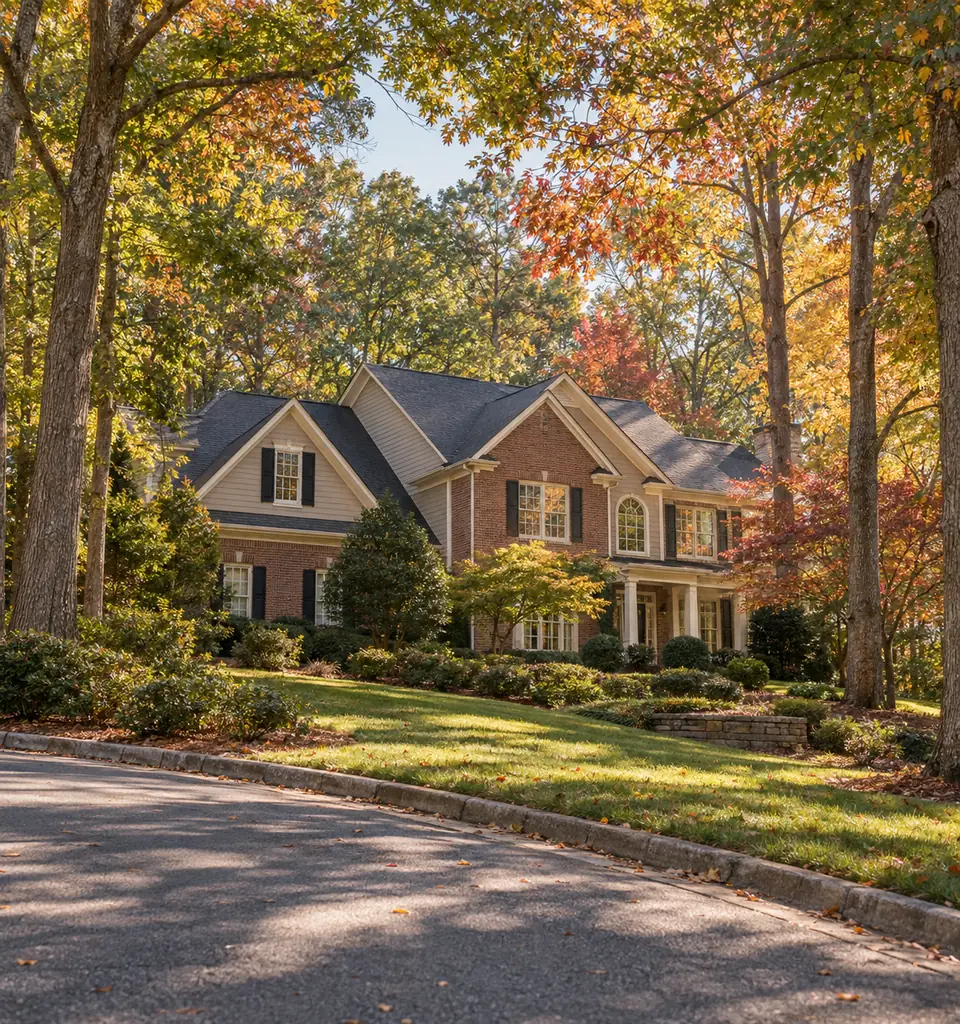
East Cobb was built mostly between the 1960s and the 1990s, with the heaviest stretch in the 1970s and 1980s. Cul-de-sac streets, two-car garages, wooded lots and a swim and tennis club at the entrance is the pattern, and that pattern is genuinely central to how people live here.
The established core. The Johnson Ferry Road, Lower Roswell Road and Sandy Plains Road corridors. Neighborhoods from the 1970s through the 1990s on roughly a quarter to three-quarters of an acre, under a mature hardwood canopy that makes the area read more wooded than most suburban Atlanta. Classic ranch and split-level designs alongside larger traditional two-stories, some substantially renovated and some still original.
The Chattahoochee River corridor. The southeastern edge, along Paper Mill Road and Columns Drive and near the Cochran Shoals and Sope Creek units of the federal park. Walking or biking distance to protected river land is rare in suburban Atlanta, and it carries its own premium that has little to do with the school zone these homes sit in.
The Shallowford corridor. North along Shallowford Road into the Sandy Plains area. Slightly larger lots, a quieter feel, and a retail and dining scene that has filled in over the last decade. Demand here has been steady from families who researched this zone specifically.
Upper East Cobb. The northernmost stretch toward Canton Road and the Cherokee County line. The most affordable entry points in the area, usually on the largest lots, and the furthest from the I-285 interchanges that make the southern end commute well.
The club communities. Indian Hills Country Club off Lower Roswell Road, Atlanta Country Club along Paper Mill Road, and Marietta Country Club toward the northern boundary. These are established golf communities rather than new ones, and membership structures vary, so I would read the club documents rather than assume the house comes with access.
What there is very little of. New construction. Available land ran out here some time ago, so most new product is infill on a remaining lot or a teardown and rebuild. If new build is a requirement rather than a preference, East Cobb may not be the right search area.
Market snapshot
What East Cobb homes are selling for.
Closed sales over the three months ending August 2026, from Redfin. Prices here vary enormously by street, school zone and condition, so I treat an area median as a starting point rather than a verdict on any one house.
A single median across all of East Cobb covers four different markets, so it describes almost nobody’s house. The practical shape of it looks more like this. Older ranch homes, townhomes and condos in the peripheral zones, generally 1,400 to 2,200 square feet and often wanting updates, tend to trade from the high $200,000s into the $400,000s. The broad middle, mostly established swim and tennis neighborhoods at 2,400 to 3,800 square feet, tends to run from about $450,000 to $700,000. The most sought-after streets, usually larger homes on larger lots with higher-end finishes, run from roughly $600,000 past $1.5 million, and custom work on the river side reaches well above that. New construction, where it exists at all, tends to start around $600,000 to $700,000.
Redfin currently describes East Cobb as somewhat competitive, with homes receiving about two offers on average. That is a different market from 2021, and sellers here have generally adjusted to it. A well-priced house in a sought-after zone still moves quickly.
Schools
How to research schools for a specific address.
I do not rank schools, and I would be cautious about any agent who does. What I can do is make sure you are researching the right ones, which is where most East Cobb buyers go wrong before they ever open a report.
East Cobb homes are served by the Cobb County School District. Not Marietta City Schools. Marietta City Schools is a separate district, the only one in Cobb County that operates independently of the county system, with its own board, its own millage and its own high school. An East Cobb address that reads Marietta, GA is still a Cobb County School District address. Families sometimes research the wrong district entirely for weeks before anyone corrects them.
The high schools serving East Cobb are Walton, Pope, Lassiter, Wheeler and Sprayberry, with Kell serving a northern portion. The middle schools include Dickerson, Dodgen, Hightower Trail, Mabry, Simpson, McCleskey and East Cobb Middle. Feeder patterns are not clean. Some middle schools split across two high school zones, so two families at the same middle school may be heading to different high schools, and that detail is easy to miss when you are touring on a Saturday.
Cobb County School District publishes attendance zone maps at cobbk12.org, under attendance zones. There are master maps for the elementary, middle and high levels, plus an individual map for each school. You find the parcel on the map for the level you care about, then confirm the feeder pattern on that school’s own page.
The district’s own wording on that page is worth repeating: the information is current as of the posted date, does not preclude future changes, and in its words, “Please do not make a future home purchasing decision solely based on this information.” For anything you are relying on, I would call the district at 770-426-3300 and have them confirm the assignment for that address in writing before the due diligence period runs out.
There is a substantial private school presence here as well, including The Walker School, Mount Paran Christian School and East Cobb Christian School, which matters to some families’ math on which zone they are willing to pay for.
Parks and the river
The part that is genuinely hard to replicate.
The Chattahoochee River National Recreation Area is federal parkland, which means the green edge of East Cobb is not going to be rezoned into townhomes. Several of its units sit right against East Cobb neighborhoods.
Cochran Shoals. The best known unit on this stretch, with a wide flat fitness loop along the water that stays busy from early morning onward. The Interstate North trailhead at 1956 Eugene Gunby Road in Marietta is another way into the same loop.
Sope Creek. Wooded single track, mill ruins and a pond, reached from Paper Mill Road. This is the one people who live nearby use on a weekday evening rather than as a destination.
Columns Drive. A long riverside road that functions as an informal running and cycling route, with river access along it. It is also the address on a number of the homes in the river corridor.
Powers Island. At 5450 Interstate North Parkway in Sandy Springs, the main canoe and kayak launch for this part of the river, with a scenic loop trail of roughly two and a half miles.
East Cobb Park. The community park, with the adjacent athletic complex. This is the local one, built around playgrounds and fields rather than trails.
Fullers Park. A county recreation park with courts and fields, and the kind of place that quietly decides which neighborhood a family with two kids in sports picks.
Shopping and dining
Where East Cobb actually goes.
There is no downtown here, because there is no town. What East Cobb has instead is a set of shopping centers that function as the social centers, and most of them are a short drive rather than a walk.
The Avenue East Cobb. The open-air center most people name first, at Roswell Road and Johnson Ferry. Giulia, an Italian bakery doing pastries and coffee, is the most recent addition drawing attention there.
Merchant’s Walk. The long-standing anchor on Roswell Road, home to SEED Kitchen and Bar, which is the closest thing East Cobb has to a serious destination restaurant, and Stem Wine Bar, which is the neighborhood’s low-key evening option.
Paper Mill Village. Smaller and more neighborhood-scaled, on the river side. Camp’s Kitchen and Bar is the anchor, with Green Coyote Cantina as the casual Mexican option.
The Shallowford and Sandy Plains centers. The retail that has filled in along the northern corridors, which is where the Lassiter-zone neighborhoods do their day-to-day shopping without driving south.
Dependable rather than trendy. Marlow’s Tavern has multiple East Cobb locations and is the reliable choice for a family or a group. Fuji Hana at Market Plaza has been the Japanese steakhouse and sushi option here for a long time.
Truist Park and the Battery. Not in East Cobb, but close enough at the southern end that it functions as the area’s nightlife and event district. Fifteen to twenty-five minutes from most of East Cobb, and much less from the Powers Ferry side.
The honest version is that East Cobb is car-dependent by design. There are walkable pockets inside individual neighborhoods and around a few of the centers, but if walking to dinner is the point of moving somewhere, this may not be the area.
Getting around
The commute, with the honest numbers.
East Cobb is outside the perimeter, and there is no MARTA rail here. For most households that means two cars and a real decision about which job hub you are driving to.
Perimeter Center and Dunwoody: 20 to 30 minutes
Via I-285 east or Powers Ferry Road. This tends to be East Cobb’s best commute, and the Perimeter corporate and healthcare corridor is a natural fit for the area. Plenty of families here run one parent to Perimeter and one to Midtown, which works.
Cumberland and the Galleria: 15 to 25 minutes
The Cobb County employment hub immediately south, with a dense concentration of offices, hotels and retail employment, plus Truist Park. The shortest commute available from most of East Cobb.
Buckhead: 25 to 35 minutes
Via Johnson Ferry Road or I-285. Better than people expect, and a common pattern for the financial services, legal and real estate corridor along Piedmont Road.
Midtown: 25 to 40 off-peak, 40 to 55 in rush
Manageable rather than easy. This is one of the most common East Cobb commutes, and it depends heavily on which end of the area you buy in.
Downtown: 25 to 40 off-peak, 40 to 60 inbound in the morning
Via I-75 south. The I-75 corridor through Cobb is heavy between roughly 7 and 9 in the morning, and this commute requires real planning rather than optimism.
Hartsfield-Jackson: 45 to 60 minutes or more
Via I-285 or I-75. The airport is on the far side of the metro from here. If you fly weekly, I would weigh this seriously before anything else on the list.
CobbLinc, the county transit system, runs express service toward Downtown and Midtown and connects to MARTA rail at Cumberland. Off-peak it is slower than driving. During rush hour it is more predictable than sitting on I-75, which is a different kind of advantage.
GDOT has proposed express lanes along the top end of I-285, the stretch that governs most East Cobb commutes heading east. The project is planned in phases and the environmental review is still in progress, and as of now GDOT has not published construction start or completion dates for the segments nearest Cobb. I would treat it as something to follow rather than a schedule you can plan a commute around.
Property taxes
What the bill is made of.
Because East Cobb is unincorporated, the tax bill has one fewer layer than a comparable house inside a city. That is a real part of why the numbers here work for some buyers who were priced out across the river.
A couple of notes on reading those figures. The county’s general fund rate is 4.07 percent above its rollback rate for 2026, which is the technical reason you may have seen it described as a tax increase even though the millage did not move. The Cumberland Special Service District, which carries its own 2.45 mills, covers the Cumberland area rather than East Cobb, so it would not normally appear on an East Cobb bill. And there may be other small line items on a specific parcel, so I would read an actual recent bill rather than build an estimate from millage alone.
Cobb County has its own floating homestead exemption, which holds the net taxable value of a primary residence steady rather than letting it climb with reassessments. For a long-term owner that compounds into something meaningful, and it is one reason a neighbor’s tax bill may look nothing like what a new buyer would pay for the same house. If you are comparing your current bill to what you would owe on a house you are buying, those are not the same calculation, and a lender’s estimate sometimes gets this wrong.
Across the river in Fulton County the structure is different, with city millage layered on top in Roswell, Johns Creek, Alpharetta and Sandy Springs. At similar price points that difference tends to favor Cobb, and for buyers comparing East Cobb to north Fulton it is worth running on the two specific addresses rather than in the abstract.
What agents get wrong
Six things I hear repeated constantly.
None of these are obscure. They are all checkable in a few minutes, which is what makes it frustrating that they keep showing up in listing copy and in advice from out-of-town agents.
Treating the Marietta address as the city of Marietta. The mailing address and the city limits are two different things. A buyer who assumes they are in the city is researching Marietta City Schools, Marietta’s millage and Marietta’s police department, none of which apply.
Talking about East Cobb as if it were a city. It has no mayor, no council and no city hall. The May 2022 referendum failed with about 73 percent against. When something needs a government, the answer is Cobb County, and knowing that saves a few wasted phone calls.
Using the ZIP code as a school zone. A single East Cobb ZIP can span more than one high school attendance area, and middle school feeders split across high school zones. Assignment follows the parcel. The district publishes a map for each individual school, and that is the thing to look at.
Reading a Roswell address as Fulton County. Part of northeastern East Cobb carries a Roswell address in 30075 while sitting in Cobb. That mistake moves the county, the school district and the tax bill all at once, and it usually goes unnoticed until someone checks the parcel.
Quoting one median for the whole area. East Cobb runs from older townhomes in the high $200,000s to custom work past several million. An area median describes the middle of four different markets and almost nobody’s actual house.
Underselling the commute, or overselling it. Perimeter and Cumberland are genuinely short drives from here. Downtown and the airport are not. Describing East Cobb as convenient without saying convenient to what is how people end up unhappy a year in.
An honest accounting
The trade offs, stated plainly.
I would rather you decide against East Cobb for the right reason than move here and find out later what you traded for the square footage.
What you gain
Space on a real lot, under trees that have been there fifty years. A quarter to three-quarters of an acre is ordinary rather than exceptional here, and the house on it tends to be larger than the same money buys inside the perimeter. You gain a tax structure with no city layer, which at the same price point tends to run lighter than north Fulton. You gain federal parkland along the river that cannot be developed, and short commutes to Cumberland, Perimeter and Buckhead. And you gain the swim and tennis neighborhood, which sounds like an amenity and functions more like the social infrastructure of the area. People stay here fifteen and twenty years, and adult children come back to buy nearby, which is not something you can manufacture.
What you trade
You trade walkability. East Cobb is car-dependent by design, and errands are drives. You trade rail transit, because MARTA rail does not come here and CobbLinc is a bus system. You trade the Downtown and airport commutes, which are real and will not improve on their own. You trade new construction, because the land is gone, so most houses will want some updating on a timeline you do not fully control. You trade nightlife, since evenings here are quiet and the closest thing to a district is the Battery. And you trade a city government, which means no city hall to call and no local council seat to show up for when something changes near you.
How it compares
What people weigh East Cobb against.
Medians below are closed sales for the three months ending August 2026. They are not quality rankings, and the right answer depends on which job hub you are driving to and which tax structure you are buying into.
Roswell, around $711,000 and rising. Across the river, in Fulton County, with city millage on top and a genuine historic downtown that East Cobb has no equivalent to. Roswell is up about 4.9 percent year over year while East Cobb is down slightly, so the gap has been widening rather than closing.
Johns Creek, around $699,000 and softening. Newer housing stock, Fulton County, and a reputation that drives its own demand. Johns Creek is down about 5.5 percent year over year, which is a steeper correction than East Cobb has seen. The commute from there to anywhere south is longer.
Alpharetta, around $789,000. The most expensive of these, with a downtown that was deliberately built and a tech employment base of its own. If your job is in Alpharetta or north Fulton, East Cobb is the wrong side of the metro for you.
The city of Marietta, around $485,000 and climbing fast. The confusing neighbor, since most East Cobb mail says Marietta. The real city is cheaper at the median, up about 10.8 percent year over year, has a walkable square, and runs its own school district. Genuinely different place, same address.
Smyrna and Vinings, around $460,000 and $600,000. Closer in, smaller lots, more townhome and condo product, and better access to I-285 and the airport side of town. If what you want from East Cobb is Cobb County taxes with a shorter drive, this is the trade to look at.
Intown Atlanta. If walkability and the Beltline are what you actually want, East Cobb will not get you there at any price, and I would say so rather than sell you the square footage.
Home search
Search homes in East Cobb.
Search is handled in one place across Metro Atlanta, so the filters, saved searches and listing detail behave the same wherever you look.
Ask about East Cobb
What do you want to know about living here?
Not a general contact form. Ask the specific thing you cannot find out from a listing photo, including which schools a particular address is actually assigned to.
Your details are used to answer your question. No automated sales sequence.
For sellers
Own a home in East Cobb?
The same address confusion that trips up buyers is what makes an automated estimate unreliable on your house. A tool that reads your address as Marietta may be pulling comparable sales from the wrong school zone, and sometimes from the wrong side of the river.
What I can tell you
Which sales are genuinely comparable to your house once they are matched on school zone, sub-market, product type, age, condition and lot, and what is actually competing with you right now. Not a Marietta average, not a ZIP-level figure, and not a headline number drawn from a sample too small to describe your street.
If you are not ready to talk yet
There is a longer write-up on what an East Cobb home is worth from the seller’s side, and a seller guide covering the process end to end, from preparation and pricing through offers and closing. No obligation attached to reading either.
Common questions
East Cobb FAQ
Seven questions buyers and sellers actually ask.
No. East Cobb is an unincorporated community in Cobb County, Georgia, with no mayor, no city council and no city property tax. A referendum on incorporating it went to voters on May 24, 2022 and failed, with about 73 percent voting against. Cobb County is the government that serves East Cobb homes.
Because the postal service assigns mailing addresses by delivery area rather than by city limits. East Cobb residents typically hold a Marietta, GA address even though they are outside the city of Marietta, and a portion of northeastern East Cobb carries a Roswell, GA address in 30075 while sitting in Cobb County rather than Fulton. The mailing city is not a reliable guide to jurisdiction, schools or taxes.
The Cobb County School District. Marietta City Schools is a separate district, the only one in Cobb County operating independently of the county system, and it serves the city of Marietta rather than East Cobb. The high schools serving East Cobb are Walton, Pope, Lassiter, Wheeler and Sprayberry, with Kell serving a northern portion. Assignment follows the specific address, and Cobb County School District publishes attendance zone maps for each school at cobbk12.org.
The median sale price was about $540,000 over the three months ending August 2026, down roughly 2.4 percent from a year earlier, with a median of about $206 per square foot. The range behind that median is wide. Older ranch homes, townhomes and condos in peripheral zones tend to run from the high $200,000s into the $400,000s, the broad middle of established neighborhoods runs roughly $450,000 to $700,000, and the most sought-after streets run from about $600,000 past $1.5 million.
There is no MARTA rail service in East Cobb. CobbLinc, Cobb County’s transit system, operates bus service including express routes toward Downtown and Midtown Atlanta and connects to MARTA rail at Cumberland. Most East Cobb households drive, and two cars tends to be the practical assumption here.
Roughly 25 to 40 minutes off-peak via I-75 south, and 40 to 60 minutes inbound during the morning rush between about 7 and 9. Perimeter Center is a shorter drive at 20 to 30 minutes, Cumberland is 15 to 25, and Buckhead is 25 to 35. Hartsfield-Jackson is the long one, at 45 to 60 minutes or more.
The ZIP codes commonly described as East Cobb are 30062, 30066, 30067, 30068, 30075 and 30328. East Cobb sits outside I-285, though the southern end runs close to it near the Powers Ferry and Cumberland interchanges. A ZIP code is not a school zone here, and several of these span more than one high school attendance area.
Find out what the parcel says before you fall for the house.
Whether you are buying in East Cobb, selling here, or weighing it against Roswell, Johns Creek, the city of Marietta or somewhere back inside the perimeter, the useful conversation starts with the parcel, the school assignment and the right comparable set, not with a number attached to a mailing city.