Metro Atlanta city guide / Cobb County
Marietta, Georgia: up 10.8 percent in a year, while its neighbor fell 6.2
Marietta is the county seat of Cobb County, laid out in 1833 and incorporated in 1852, with about 63,500 residents across 23.45 square miles. It has the strongest historic downtown outside the perimeter, a national battlefield on its northern edge, and a market that went up 10.8 percent this year while the city eight miles south of it went down 6.2. It also has the widest gap between a mailing address and a city in this entire metro, and here that gap decides which school district your children attend. Sort that out first. Everything else follows from it.
Come as you are. Come on home.
Start here
The city has 63,500 people. The mailing address has 334,722.
That is not a rounding difference. Roughly 271,000 people with a Marietta address live outside the City of Marietta, which means about five out of every six Marietta addresses belong to somewhere else. No other place in this series comes close.
Seven ZIP codes carry a Marietta address and have people living in them: 30008 (32,435), 30060 (39,890), 30062 (66,889), 30064 (50,568), 30066 (62,417), 30067 (47,653) and 30068 (34,870). That is 334,722 between them. The City of Marietta itself was 60,972 at the 2020 census and is estimated near 63,574 for 2025.
The other Marietta ZIPs you may see, 30006, 30007, 30061, 30065, 30063 and 30069, have no residential population at all. They are PO boxes and business-only codes.
Most of that 271,000 is East Cobb. If you have been reading about East Cobb and seeing Marietta addresses attached, that is why. East Cobb is unincorporated Cobb County. It has no city government of its own and it is not Marietta, whatever the envelope says.
Why this one costs more than the others
In most places a city line moves the tax bill and the trash pickup. Here it moves the school district.
Inside the city limits, public schools are Marietta City Schools, an independent district founded in 1892 with about 8,600 students. Outside the city limits, with the identical mailing address, they are the Cobb County School District, which serves more than 100,000 students. These are two separate governments with separate boards, separate budgets and separate calendars. A family that researched one and bought into the other has researched a school system their children will not attend.
Marietta runs its own electric and water utility, Marietta Power, created in 1906 and serving more than 45,000 customers through the Board of Lights and Water. Its service area is described as Marietta and Cobb County, so it reaches past the city limits, and some addresses get electric only while others get water only.
So three boundaries are in play here and no two of them line up: the ZIP code, the city limit that sets your school district, and the utility service area that sets who sends your power bill. I would confirm all three from the parcel before writing an offer, and I would not accept a listing’s word for any of them.
At a glance
The county seat, since 1833.
These hold steady from month to month, which makes them the right place to start a search.
Where it sits
Who Marietta borders.
Marietta sits about twenty miles northwest of downtown Atlanta with I-75 along its western side and the Square about a mile east of the interstate. It is ringed almost entirely by unincorporated Cobb County, which is the root of the address problem.
North: Kennesaw Mountain and the city of Kennesaw
Kennesaw Mountain National Battlefield Park sits on the northern edge, 2,965 acres of preserved ground with trails and earthworks. Past it is Kennesaw, a separate incorporated city served by Cobb County Schools, generally cheaper, and oriented toward I-575 and Kennesaw State University rather than toward Atlanta.
East: East Cobb, which is not a city
The largest share of those 271,000 non-city Marietta addresses. Unincorporated, governed entirely by the county, served by Cobb County Schools, and home to the attendance zones that bring families across the region. Larger lots, more swim and tennis, no downtown. The boundary between the two is invisible on the ground and decisive on paper.
South: Smyrna, Cumberland and The Battery
Smyrna is the other Cobb city with a real walkable downtown, about eight miles south. Between them sits the Cumberland and Galleria employment district with Truist Park and The Battery, which are in unincorporated Cobb rather than in either city. Ten to twenty minutes from most of Marietta, and the best commute the city has.
West: west Cobb and Powder Springs
Out past the interstate the character turns conventionally suburban, with newer subdivisions on larger lots and lower prices. Dobbins Air Reserve Base and the Lockheed Martin plant sit on the south and west side of the city, which is a large employment base and also the reason some neighborhoods hear aircraft.
Housing stock
Victorians, bungalows, and everything built since.
Marietta has older housing than almost anywhere else in Cobb County, because it was a real town before the suburbs arrived. The spread inside the city limits is wide, and the age of a house changes what due diligence it needs.
Square-adjacent historic. The blocks radiating north and east of Glover Park hold Victorian-era houses, craftsman bungalows and early twentieth century builds on modest lots with mature trees. Kennesaw Avenue, Polk Street and Cherokee Street are the names you will see. These walk to the Square, they carry a premium for it, and they move faster than the rest of the city.
Six historic districts. The city has six officially recognized historic districts. If a house sits in one, exterior changes can need review. That is not a reason to avoid them, but it is a question to ask before you plan a renovation, not after.
The inner ring of mid-century. Ranches and traditional builds from the 1950s through the 1980s wrapping the historic core. Larger lots, solid bones, and the widest renovation opportunity in the city. This tier is where Marietta tends to offer more house per dollar than the equivalent in East Cobb.
Townhomes and infill. A decade of townhome development has filled in gaps near the interstate and along the arterials, aimed at first-time buyers and downsizers who want the amenity base without an old house. New single family inside the city is limited and usually a teardown and rebuild on an existing lot.
Indian Hills. A golf community on Lower Roswell Road that straddles the Marietta and East Cobb boundary area. Wooded lots, established landscaping, country club character, and higher prices. Also a place where the city limit question genuinely matters, since the neighborhood sits across the line.
An honest note on old houses. A house built in the 1890s has character that nothing new can imitate, and it also has 130 years of foundation, plumbing, electrical and structural history. I would budget for a thorough inspection with someone who works on historic homes regularly, and I would expect to find deferred maintenance rather than hope not to.
Market snapshot
Up, while most of Cobb is down.
Figures below cover August 2026. Marietta is the strongest market in Cobb County right now by a clear margin, and that is the opposite of what a lot of older copy about this city will tell you.
Read the median and the price per square foot together. The median is up 10.8 percent and price per square foot is up 6.1, which means part of the move is genuine appreciation and part is a shift in what sold. Both point the same way, so this is a real strengthening rather than a trick of the mix.
The supporting indicators agree. The share selling above list rose while the share taking a price drop fell, and the sale-to-list ratio went up rather than down. Volume was essentially flat at 201 sales against 204. The competitiveness score sits at 62 out of 100 with about two offers on a typical home, which is the highest of the Cobb markets covered on this site.
Smyrna is eight miles south, also an incorporated Cobb city, also with a real walkable downtown. Over the same month its median fell 6.2 percent and its price per square foot fell 6.3, its price drops ran at 38.8 percent, and a typical home drew about one offer.
Two similar cities, eight miles apart, moving opposite directions in the same year. If you are weighing them, that difference is worth more to your decision than either median on its own, and it is the kind of thing a citywide average will never tell you.
Schools
Two districts, one mailing address.
This is the part that costs people money, so it gets stated plainly. The city line decides your district. The envelope does not. I do not rank or grade schools, and I would be careful with anyone who does.
First establish whether the specific address is inside Marietta city limits. The City of Marietta can confirm that, and so can the parcel record. If it is inside, the district is Marietta City Schools and they will confirm the zoned schools for that address. If it is outside, the district is Cobb County School District and their locator applies instead.
Being inside the city does not by itself put you in a particular school. Zoning still applies within the district. I would get the answer in writing before making an offer if a specific school matters to you.
Marietta City Schools was founded in 1892 and serves roughly 8,600 students. The schools you will see named:
Elementary. A.L. Burruss, Dunleith, Hickory Hills, Lockheed, Park Street, Sawyer Road and West Side.
Middle. Marietta Sixth Grade Academy, then Marietta Middle School for seventh and eighth.
High. Marietta High School, the district’s one high school.
Early learning and specialty. The Early Learning Center and the Emily Lembeck Early Learning Center, plus the Marietta Center for Advanced Academics, the College and Career Academy, the Woods Wilkins Campus and the Marietta Performance Learning Center.
Private and independent nearby. The Walker School and Mount Paran Christian School are both in Marietta, with other faith-based and independent options across the area.
The honest framing. Marietta City Schools is small, urban and mixed in a way the surrounding county district is not, with one high school rather than a dozen. Whether that suits a particular family is a question to answer by visiting, not by reading a number. The same goes for the Cobb County zones next door.
Marietta Square
A downtown that was not invented for the brochure.
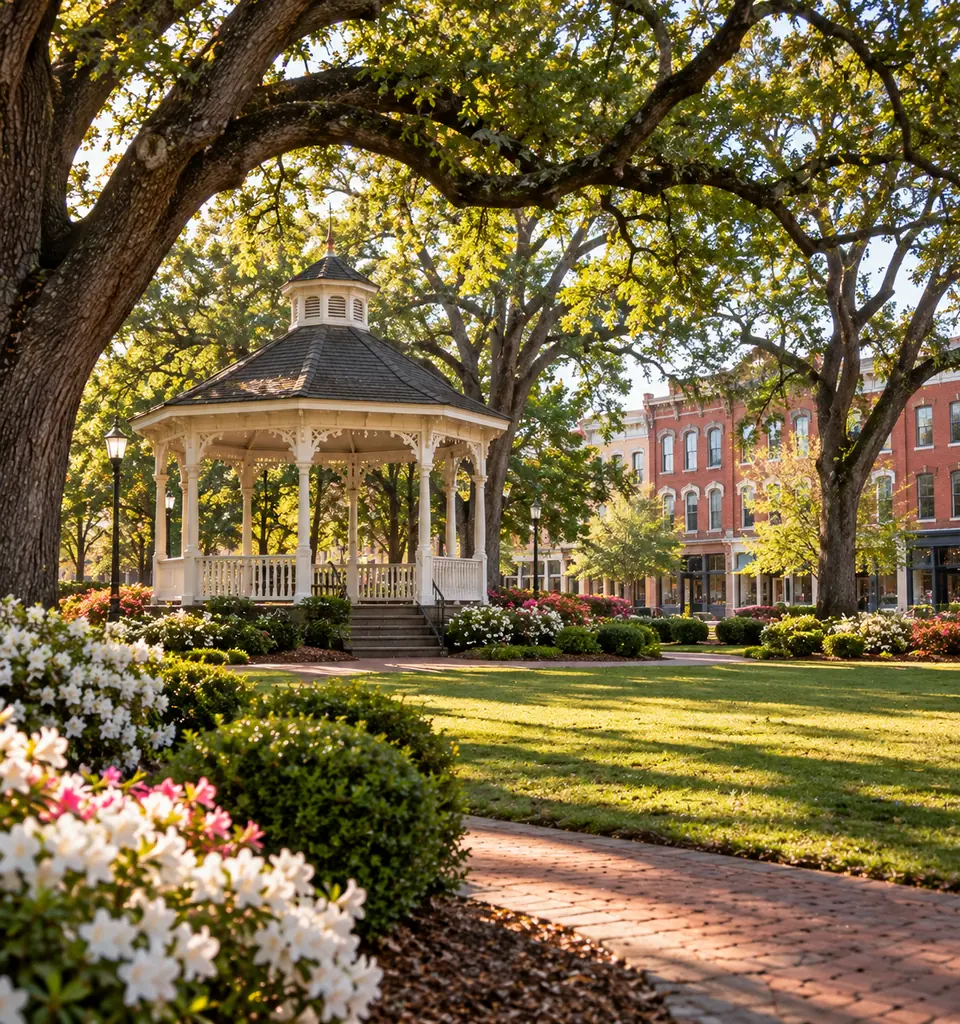
Glover Park is a Victorian public green with a gazebo, ringed by late nineteenth and early twentieth century commercial buildings that are still commercial buildings. Most of what you will find around it is independent rather than chain, which is why it reads differently from the lifestyle centers elsewhere in the metro.
Around the Square. Restaurants, galleries and small shops occupy the historic storefronts on all four sides. Johnnie MacCracken’s sits inside the restored 1885 Marietta Fire Station No. 1, the first professional fire department in Georgia, which tells you something about how the city reuses its own buildings.
Marietta Square Market. A food hall in a revitalized warehouse beside the working railroad tracks, with nineteen or more eateries under one roof. Korean, Neapolitan, New Orleans, Mediterranean, ramen, Thai. It functions as a community dining room rather than an attraction.
The Strand Theatre. A 1935 theater on the Square still running live performances, films, concerts and comedy, with a lounge and a rooftop bar.
The calendar. Taste of Marietta draws around 50,000 people for a day. The Glover Park Concert Series runs free outdoor shows on the last Friday of the month from April through September. Chalktoberfest closes streets for chalk artists. There is a seasonal farmers market.
Museums. The Marietta Museum of History in the Kennesaw House, the Marietta Cobb Museum of Art, the Marietta Fire Museum, and the Root House, an 1845 merchant’s home and one of the oldest buildings left in the city.
What walkable actually means here. The neighborhoods immediately around the Square genuinely walk to all of it. Most of the city does not, and the drop-off is quick. If walkability is the reason you are looking at Marietta, buy within that radius and understand you are paying for it.
Parks and history
A national battlefield at the end of the street.
Marietta’s outdoor assets are unusual for a city this size, and most of them are tied to the same 1864 campaign that shaped the place.
Kennesaw Mountain National Battlefield Park. 2,965 acres on the northern edge of the city, preserving ground where opposing forces maneuvered and fought from 19 June to 2 July 1864, with the main assault on 27 June. Hiking and biking trails, preserved earthworks, cannon positions, ranger programs, and views toward the Atlanta skyline from the summit on a clear day. Parking fills early on weekends.
The city’s own Civil War layer. Union forces occupied Marietta during the Atlanta Campaign. Sherman used the Kennesaw House, now the Museum of History, as a headquarters in July 1864, and the city burned that November. Historic markers around the Square and the surrounding neighborhoods are specific about what happened where.
Sope Creek. The Sope Creek unit of the Chattahoochee River National Recreation Area, reached from Paper Mill Road, holds the ruins of a Civil War paper mill and connects into the wider Cochran Shoals trail network. Unpaved, wooded, and busy on weekend mornings.
Six Flags White Water. A 70-acre waterpark on North Cobb Parkway that functions as a summer institution for Cobb County families.
Laurel Park. A city park with sports facilities, tennis courts and walking paths, and one of the places city recreation programming actually happens.
What the city does not have. No equivalent of the Silver Comet, which starts in Smyrna, and no river frontage of its own. The trail network here is wooded and hilly rather than flat and paved, which suits some people and not others.
Getting around
Twenty miles out, on the busiest road in the metro.
Marietta sits about twenty miles northwest of downtown with I-75 along its western edge. The jobs in Cobb County are close. The jobs in Atlanta are a real commute, and I would rather you hear that from me than discover it in March.
Cumberland, Galleria and The Battery, 10 to 20 minutes. The county’s main employment cluster, and Marietta’s strongest commute by some distance. Close enough to be practical, not close enough to walk.
WellStar Kennestone, inside the city. One of Georgia’s largest hospitals and a major employer, which means a meaningful share of people here have a commute measured in single-digit minutes.
Perimeter and Dunwoody, 20 to 30 minutes. Either I-285 east or Powers Ferry Road. Reliable enough to plan around.
Buckhead, 25 to 35 minutes. I-75 south to I-285 east, or Cobb Parkway to Powers Ferry if the interstate is behaving badly.
Downtown and Midtown, 20 to 40 minutes off peak. Add twenty to thirty minutes each way in rush hour. The I-75 run from Marietta into the city is one of the heaviest commutes in the region and it does not get better by wishing.
Hartsfield-Jackson, 30 to 45 minutes off peak. Longer in rush hour. Workable if you fly occasionally, tiring if you fly weekly.
No MARTA rail serves Marietta. CobbLinc runs bus routes through the city and connects to MARTA at the Marietta Transfer Center, and the Cumberland Circulator covers the Battery area. That is a usable system for some trips and it is not a car-free life. If your household genuinely needs rail, this is the wrong city and I would say so before you toured it.
Dobbins Air Reserve Base sits on the south side with the Lockheed Martin plant beside it. It is a large employment base and it is also an active airfield, so I would spend time on a street before buying on it rather than relying on a map.
Property taxes
The city line changes who taxes you for schools.
Most places, crossing a city line adds a city levy on top of everything else. Here it adds a city levy and swaps the school levy, which is the larger of the two and the one buyers rarely look at.
A property inside the city pays City of Marietta millage, Cobb County millage and the Marietta City Schools levy. A property outside the city, carrying the same Marietta mailing address, pays no city millage and pays the Cobb County School District levy plus the county fire fund instead.
Two wrinkles worth knowing before you estimate anything. Properties inside certain downtown boundaries also carry 1.647 mills for the Downtown Development Authority, and properties in the Gateway Marietta CID carry 5 mills on top. And the city schools rate, though unchanged at 17.97, sat about 5.95 percent above its rollback rate for 2026, which is why it was advertised as a tax increase even with the number flat.
Do not add these up on paper. Pull the most recent tax bill for the exact parcel. It names every levy that applies, which also settles the city-limits question and therefore the school district question in one step. If you are comparing a house inside the city to one a mile away outside it, run both bills side by side rather than comparing millage tables.
And remember that a bill reflecting a long-time owner’s exemptions and freezes is not the bill you will receive. Ask what the number looks like reassessed at your purchase price.
City line or school line
In Marietta, nearly every error is a line on a map.
All six are checkable in a few minutes, which is what makes it frustrating that they keep showing up in listing copy and relocation packets.
Treating a Marietta address as Marietta City Schools. The biggest and most expensive error in this market. About five out of six Marietta addresses are outside the city and in the Cobb County School District. Families have bought for a district their children were never going to attend.
Running it the other way, and missing the city entirely. Buyers who want the walkable Square and the historic housing search “Marietta” and get 334,722 people’s worth of results, most of them conventional East Cobb subdivisions. Then they conclude Marietta is not what they heard it was. Filter by city limits, not by city name.
Saying Marietta is the affordable option and leaving it there. It was. The median is now $485,429, up 10.8 percent on the year, while Smyrna, East Cobb and Kennesaw are all down. Copy written a year ago has the direction backwards.
Putting Truist Park and The Battery in Marietta. They are in unincorporated Cobb, eight to ten miles south. Good access, genuinely. Not walkable, and not in the city.
Pricing a historic house off mid-century comparable sales. An 1890s Victorian two streets from Glover Park and a 1968 ranch a mile out are not the same product, do not attract the same buyer, and do not sell on the same timeline. A citywide median describes neither.
Assuming the power company. Marietta runs its own electric and water utility, and its service area does not follow the city limits either. It is a small thing until it is the thing nobody checked.
What it costs
The trade, in plain terms.
Marietta gives you a lot. It also asks for things, and those tend to be easier to live with when you saw them coming.
What you gain
The strongest historic downtown outside the perimeter, and one that grew rather than being designed. You gain housing with genuine age and character, which almost nowhere else in Cobb County offers at this scale. You gain a 2,965 acre national battlefield on the edge of town and the Sope Creek trails a short drive away. You gain the county’s healthcare and government hub inside your own city limits, and the Cumberland employment cluster ten to twenty minutes away. You gain a small independent school district if you want one, which is a genuinely different choice from a hundred-thousand-student county system. And right now you gain a market that is rising while its neighbors fall, which matters if you are buying to hold.
What you trade
You trade certainty about what you are buying, more here than anywhere else in this series, because the address tells you almost nothing and the school district turns on it. You trade the Cobb County attendance zones that bring families to East Cobb, which are outside the city by definition. You trade rail, since no MARTA reaches Marietta and the bus is a connection rather than a commute. You trade an easy run into Atlanta, because I-75 southbound in the morning is as bad as its reputation. You trade the simplicity of a newer house if you buy near the Square, along with the inspection budget that comes with it. And you trade the buyer’s leverage available eight miles south, because this is the one Cobb market where sellers currently have the better of it.
How it compares
What people weigh Marietta against.
The Cobb medians below all cover August 2026 from the same source, so they are comparable to each other. They are not quality rankings, and one month in a small market can move a long way without meaning much.
East Cobb, around $539,700 and down 2.5 percent. The comparison that matters most, because most people weighing it do not realize they are comparing a city to an unincorporated area with the same mailing address. Larger lots, swim and tennis, the Cobb County attendance zones, no downtown, and currently moving down while Marietta moves up.
Smyrna, around $459,700 and down 6.2 percent. The other Cobb city with a real walkable downtown, eight miles south, closer to the perimeter and to the Silver Comet. Cheaper right now and getting relatively cheaper. If your commute runs south, Smyrna usually wins it.
Kennesaw, around $371,800 and down 5.9 percent. The northern neighbor, noticeably cheaper, Cobb County Schools, oriented toward I-575 and Kennesaw State. More house for the money, longer run to anything south.
Vinings, around $619,600. Expensive, unincorporated, and reading up 27.8 percent on a thin month of sales that I would not take at face value. Relevant mainly as the upper bound on this side of the county.
Roswell, about $692,000 as of September. Canton Street and Marietta Square are the two real historic downtowns on the north side, so this is the honest out-of-county comparison. Roswell is Fulton rather than Cobb, which means a different school system and a different tax structure, and it runs considerably more expensive. Note the month differs from the Cobb figures above.
The direction, not just the level. Marietta up 10.8 percent while East Cobb, Smyrna and Kennesaw are all down is the most useful single fact in this section. Four Cobb markets, one going the other way.
Home search
Search homes in Marietta.
Search is handled in one place across Metro Atlanta, so the filters, saved searches and listing detail behave the same wherever you look.
Ask about Marietta
What do you want to know about living here?
Not a general contact form. Ask the specific thing you cannot find out from a listing photo, including whether a particular address is inside the city limits and which school district it actually belongs to.
Your details are used to answer your question. No automated sales sequence.
For sellers
Own a home in Marietta?
This is the better side of Cobb County to be selling from this year. The median is up 10.8 percent, more homes are closing above list than a year ago, and fewer are taking price drops. That is a real position and it is worth pricing from the current market rather than last year’s.
What I can tell you
Which sales are genuinely comparable to your house once they are matched on city limits status, school district, era, condition and lot, and what is actually competing with you right now. An automated estimate reading your address as Marietta may be pulling comparable sales from unincorporated East Cobb, which is a different district, a different tax bill and a different buyer. On an older house near the Square it will also undervalue work that does not show up in square footage.
If you are not ready to talk yet
There is a seller guide covering the process end to end, from preparation and pricing through offers and closing. No obligation attached to reading it.
Common questions
Marietta FAQ
Seven questions buyers and sellers actually ask.
Usually not. The City of Marietta holds about 63,500 people, while the seven residential Marietta ZIP codes hold 334,722 between them. Roughly five out of six Marietta addresses sit outside the city, mostly in East Cobb, and those are served by the Cobb County School District. Only properties inside the city limits are served by Marietta City Schools. The two are separate districts with separate boards and budgets, so this is worth confirming from the parcel before you make an offer.
Not from the ZIP code, and not from the listing. The parcel record settles it, and the City of Marietta can confirm an address directly. Once you know the answer, the school district follows from it: inside means Marietta City Schools, outside means Cobb County School District. I would also check the utility, since Marietta Power’s service area does not follow the city line either.
The median sale price was about $485,400 in August 2026, up 10.8 percent from a year earlier, at roughly $216 per square foot. The spread inside the city is wide, because it blends Victorian and craftsman houses near Glover Park, mid-century ranches in the inner ring, and a decade of townhome infill. Pricing by product type and by distance from the Square will tell you more than the citywide figure.
Up, and it is the exception in Cobb County. In August 2026 the median rose 10.8 percent year over year and price per square foot rose 6.1 percent. The share of homes selling above list went up to 16.9 percent while the share taking a price drop fell to 34.2 percent, and the sale-to-list ratio improved slightly to 98.1 percent. Over the same month East Cobb was down 2.5 percent, Smyrna down 6.2 and Kennesaw down 5.9. Redfin scores Marietta 62 out of 100, somewhat competitive, at about two offers per home.
Inside the city you pay City of Marietta millage at 4.62, Cobb County general fund at 8.46, and the Marietta City Schools levy at 17.97, which was held flat for 2026 but sat about 5.95 percent above its rollback rate. Outside the city, with the same mailing address, there is no city millage and the school levy is the Cobb County School District’s 18.70 instead, plus the county fire fund. Some downtown properties also carry a 1.647 mill Downtown Development Authority levy or 5 mills for the Gateway Marietta CID. Georgia taxes 40 percent of appraised value. The reliable way to compare two addresses is to pull the actual bill for each parcel.
The historic center of the city, built around Glover Park, a Victorian public green with a gazebo. Late nineteenth and early twentieth century commercial buildings ring it on all four sides, holding mostly independent restaurants, galleries and shops. The Marietta Square Market food hall sits beside the railroad tracks with nineteen or more eateries, and the 1935 Strand Theatre is on the Square itself. Taste of Marietta, the Glover Park Concert Series and Chalktoberfest all happen here. The neighborhoods immediately around it walk to all of it; most of the city does not.
No MARTA rail. CobbLinc buses run through the city and connect to MARTA at the Marietta Transfer Center, which works for some trips but is not a car-free arrangement. Driving, Cumberland and Galleria are 10 to 20 minutes, Perimeter 20 to 30, Buckhead 25 to 35, Downtown and Midtown 20 to 40 off peak, and the airport 30 to 45. The caveat is I-75 southbound in the morning, which can add twenty to thirty minutes each way and is one of the heaviest commutes in the region.
Find out which side of the line you are on before you fall for the house.
Whether you are buying in Marietta, selling here, or weighing it against East Cobb, Smyrna, Kennesaw or Roswell, the useful conversation starts with the parcel, the school district and the right comparable set, not with a city name printed on an envelope that five out of six times belongs to somewhere else.